
Parts Hoppers & Material Hoppers: Storage and Dispensing Equipment for Finishing Operations
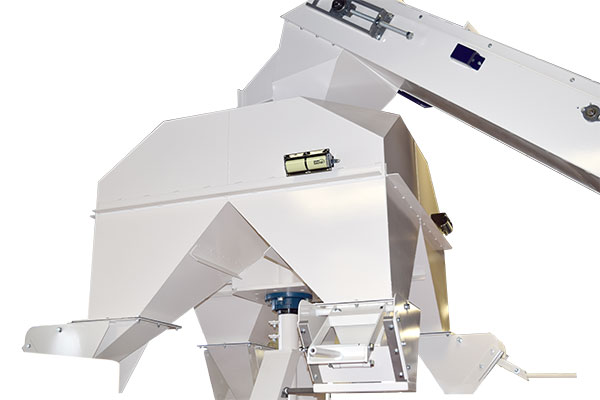
ALMCO parts hoppers and material hoppers store, stage, and dispense bulk parts or finishing media at the workstation, eliminating the heavy lifting, shoveling, and drum handling that slow down production and create operator injury risk. Built for the demanding environments of industrial finishing operations, ALMCO hopper equipment is available in portable, stationary, rotating, and traveling configurations to fit your production layout, media changeover requirements, and automation goals.
Hoppers are most commonly used in two scenarios: storing bulk parts between operations (feeding a finishing machine on demand), and holding finishing media between cycles or during media changes. In integrated finishing systems with multiple machines, stationary media hoppers store media after an external screener separates it from finished parts, allowing the media to be returned to the finishing machine for the next cycle without manual handling. ALMCO manufactures every parts hopper in Albert Lea, Minnesota, with heavy-gauge or stainless steel construction engineered for years of continuous service. Hoppers integrate seamlessly with ALMCO parts conveyors, screeners, vacuum systems, and finishing equipment.
Standard Features
- Heavy-Gauge or Stainless Steel Construction: Mild steel with protective finish is standard for dry or non-corrosive environments; stainless steel is specified for wet applications, chemical exposure, or food-grade and medical-adjacent manufacturing. Heavy-gauge construction withstands the weight of fully loaded bulk media without deformation.
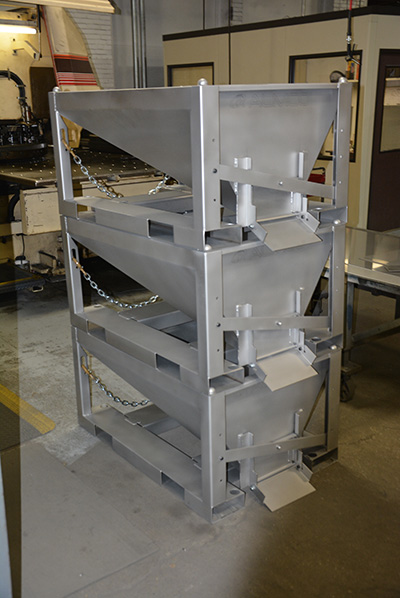
- Fork Pockets on Portable Hoppers: Integrated fork pockets allow portable hoppers to be moved between workstations, staging areas, or media storage by forklift, no disassembly or crane required. This is critical for facilities that run multiple media types or rotate hoppers through production zones.
- Controlled-Discharge Doors: Discharge doors are engineered for precise, repeatable release of parts or media. Controlled discharge prevents over-loading downstream equipment, minimizes dust and spillage, and supports integration with conveyors or machine infeeds that require metered feeding.
Available Options
- Interior Lining for Noise Reduction: Polyurethane or rubber interior linings reduce the impact noise of parts or media dropping into empty hoppers, particularly important in facilities with noise exposure limits or open production layouts where operator comfort affects productivity.
- Powered Rotating or Traveling Conveyors: Hoppers integrated with powered conveyors automatically dispense and transfer media or parts into downstream equipment, eliminating the need for an operator to manage flow rate. Rotating configurations serve machines arranged in radial layouts; traveling configurations move along linear production lines.
- Powered Discharge Doors: Pneumatic or electrically actuated discharge doors can be controlled by PLC, sensor, or timer, enabling fully automated dispensing cycles in integrated production cells without operator intervention.
- Bin Level Indicators: Ultrasonic, capacitive, or mechanical level indicators provide visual or electronic signal when hopper contents approach empty or full. Essential for automated systems where downstream equipment depends on continuous hopper supply.
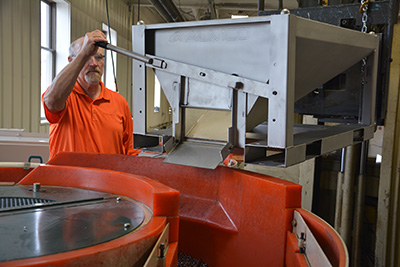
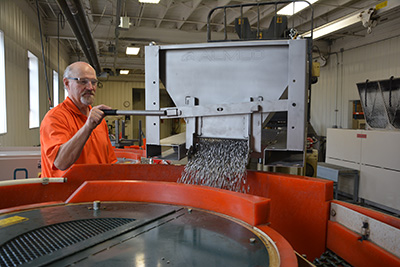
Hopper Configurations for Finishing Operations
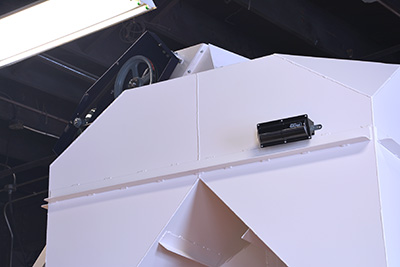
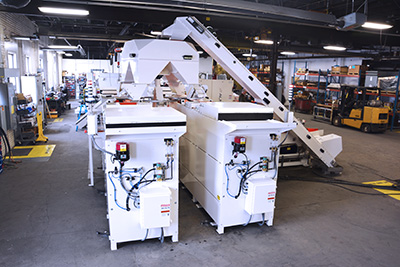
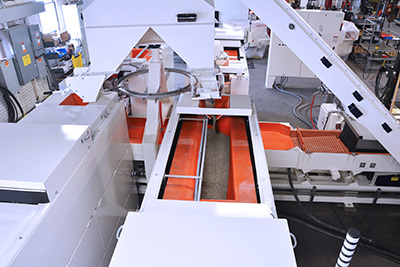
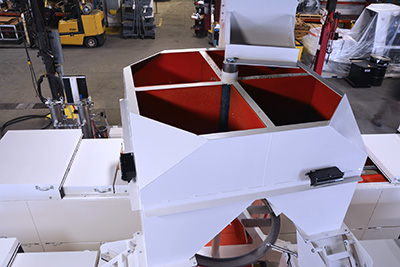
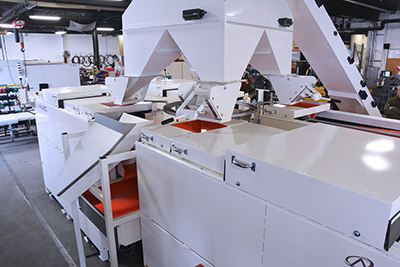
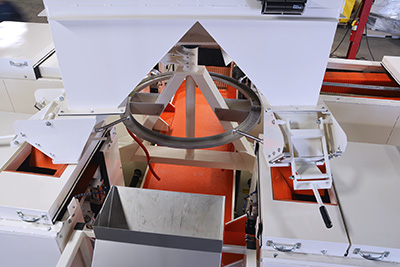
ALMCO manufactures hopper equipment in four primary configurations. The right choice depends on whether your application calls for manual handling between workstations, fixed-position bulk storage, or integrated automated dispensing.
Portable Hoppers
The most common configuration. Portable hoppers are built on a heavy-duty base with integrated fork pockets, allowing forklift movement between storage, loading stations, and finishing equipment. Ideal for facilities that use multiple media types, rotate hoppers through production areas, or stage media changeovers without disrupting production. Portable hoppers can also serve as temporary bulk part storage between upstream machining and finishing operations.
Stationary Hoppers
Fixed-position hoppers that remain in a dedicated spot, typically integrated directly with a finishing machine or discharge point. Stationary hoppers are common in high-volume operations with dedicated media types, where the added cost of relocating hoppers isn’t justified. These hoppers can be plumbed for vacuum fill, integrated with level sensors, and connected directly to machine infeeds via gravity discharge or powered conveyor.
Rotating Hoppers
Rotating hoppers feature a powered conveyor or dispensing mechanism that can pivot to serve multiple finishing machines arranged in a radial layout. This configuration maximizes hopper utilization when one media supply needs to feed several stations. Rotating hoppers are less common than portable or stationary configurations but are valuable in space-constrained cells.
Traveling Hoppers
Traveling hoppers move along a track or rail to serve multiple machines arranged in a linear production line. A single hopper can dispense media or parts to stations along the line without being relocated by forklift. Common in automated, high-throughput cells where centralized media storage is preferred over dedicated hoppers at each machine.
Parts Hoppers vs. Media Hoppers: What’s the Difference?ALMCO hopper equipment handles two distinct applications in finishing operations, bulk part storage and finishing media management. While the core hopper design is similar, the specification details differ based on what’s being stored and how it flows. Parts HoppersA parts hopper stores bulk unfinished components (stampings, small machined parts, castings) between upstream operations and the finishing machine. Parts hoppers feed components onto a conveyor or directly into a finishing machine infeed at a controlled rate, eliminating the need for an operator to hand-load the machine. Key design considerations include part geometry and flow characteristics (round parts flow differently than flat or irregular parts), hopper angle to promote reliable discharge, and containment features to prevent small parts from escaping during transport or dispensing. Media HoppersA media hopper stores finishing media, typically ceramic, plastic, steel, or synthetic abrasive, between finishing cycles or during media changes. In integrated systems with external screeners, media hoppers receive separated media from the screener and hold it until it’s returned to the finishing machine for the next cycle. Key design considerations include material compatibility (wet media may require stainless steel or protective coating), weight support (loaded media hoppers can weigh thousands of pounds), drainage and ventilation for wet media, and dust containment for dry abrasive media. Dual-Purpose HoppersSome facilities specify hoppers that can be used interchangeably for parts or media depending on the production schedule. ALMCO can design dual-purpose hoppers with modular discharge geometry, interchangeable dispensing mechanisms, and neutral interior finishes that don’t contaminate either application. |
Where Parts Hoppers and Media Hoppers Fit in Your OperationAutomated Machine LoadingA portable parts hopper stages bulk components at floor level next to a vibratory bowl or centrifugal disc finisher. A conveyor transfers parts from the hopper to the machine at a controlled rate. The result: one operator loads the hopper once per shift instead of hand-loading the machine dozens of times per day. Media Management in Integrated Finishing SystemsIn a typical integrated deburring cell: parts discharge from a vibratory finisher onto a screener that separates parts from media. Separated media drops into a stationary media hopper, where it’s held until the next cycle. When the operator starts the next batch, media is returned to the finishing machine via powered conveyor or vacuum system, without any manual handling. Multi-Media Production EnvironmentsFacilities running multiple finishing processes on the same machine (coarse deburring with ceramic media one day, polishing with plastic media the next) use portable hoppers to stage each media type. Forklift-moved hoppers allow rapid changeovers, spent media is vacuumed into a return hopper, and fresh media is dispensed from the staging hopper, turning a multi-hour changeover into a single-operator task. Media Storage Between Production RunsBulk media is expensive, and leaving it in a finishing machine when the machine isn’t in use wastes that capital investment. Portable hoppers provide a mobile storage solution, media can be evacuated from the machine, stored in hoppers, and returned when production resumes. This is especially valuable for facilities with seasonal production variation or multiple part families running through the same equipment. Ergonomic & Safety ImprovementsShoveling media from drums, lifting media bags over machine edges, and manually staging parts all create repetitive-strain injury risk and slow production. The combination of hoppers, vacuum systems, and conveyors eliminates nearly all manual media and bulk parts handling from the finishing workflow. |