
Vacuum Material Handling Systems: Media Transfer and Recovery Equipment for Finishing Operations
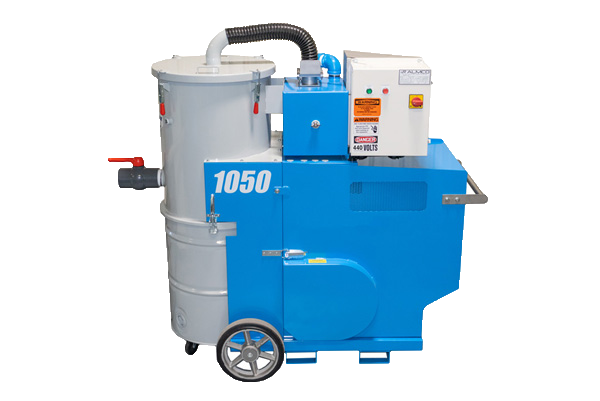
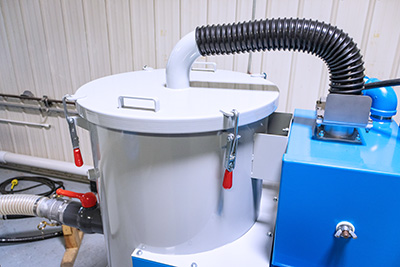
ALMCO vacuum material handling systems move finishing media and small bulk parts between finishing machines, hoppers, drums, and storage containers, without shoveling, lifting, or manual transfer. Custom-designed for each application, these vacuum loading systems eliminate the ergonomic injury risk associated with manually handling heavy or abrasive media, speed up media changeovers, and enable fully automated media recovery loops in integrated production cells. Whether you need to evacuate spent media from a single vibratory tub or automate the full media return loop across a multi-machine finishing line, ALMCO engineers the right vacuum material handling equipment for the job.
Vacuum processing equipment is most valuable in three scenarios: emptying machines during media changes or maintenance, transferring media back to finishing equipment after parts are separated, and moving spent media to disposal or reclaim containers. In every case, ALMCO material handling vacuum systems replace the most physically demanding and injury-prone tasks in a finishing operation with automated, contained material transfer. These systems integrate seamlessly with ALMCO hoppers, screeners, parts conveyors, and finishing equipment.
Standard Features
- Heavy-Duty Industrial Vacuum: Built for continuous operation in abrasive, dusty finishing environments. Industrial-grade vacuum motors and filtration systems handle the demanding conditions of media transfer without the degradation that plagues standard shop vacuums. Capacity is matched to the media volume and transfer distance of your specific application.
- Application-Specific Suction Nozzle: The nozzle is engineered to match the media type, particle size, and machine geometry you’re evacuating. Ceramic media requires a different nozzle geometry than plastic media or small parts, matching the nozzle to the application prevents clogging, maximizes transfer rate, and protects the media from damage during handling.
- Custom-Designed for Your Application: Every ALMCO vacuum material handling system is engineered around the specific machines, media types, transfer distances, and destination containers in your facility. This eliminates the compatibility issues common with off-the-shelf industrial vacuums that weren’t designed for finishing-specific workflows.
Available Options
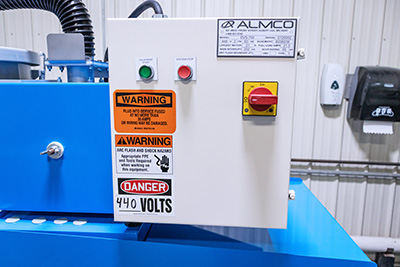
- Voltage and Electrical Control Options: Systems available in common industrial voltages with control options ranging from basic manual start/stop to PLC-integrated operation with sensor-triggered cycles, timer-based runs, and interlocks with connected finishing equipment.
Multiple Storage Container Types: Transfer media directly into a fixed hopper for immediate reuse, a portable drum or cart for forklift relocation, or a dedicated storage bin for long-term holding. Container choice depends on how the media will be used next, reused in the next cycle, replaced with new media, or disposed of as spent material.
Why Vacuum Material Handling Pays for Itself
The alternative to a vacuum loading system is manual media handling, shoveling spent media out of finishing tubs, lifting drums of fresh media up to machine tops, and sweeping floors after messy transfers. These tasks are among the most injury-prone activities in a finishing operation, and they consume significant operator time across every production shift. The right vacuum material handling equipment typically pays back the investment within months.
Operator Safety & Ergonomic Risk Reduction
Shoveling 50–100 pounds of wet or dry media out of a vibratory tub, lifting drums of replacement media, and carrying buckets of spent media across the shop floor all create serious repetitive-strain and lifting injury risk. Back injuries from media handling are among the most common causes of lost time in finishing operations. A vacuum material handling system eliminates the lifting entirely, media flows through a hose, not on an operator’s back.
Faster Media Changeovers
Manually emptying a finishing machine, shoveling, bagging, and disposing of old media, then lifting in replacement media, can take hours, during which the machine isn’t producing parts. A vacuum loading system can evacuate a machine in minutes, dramatically reducing changeover time and increasing the number of production hours available per shift. Facilities running multiple media types through the same equipment see the largest gains.
Cleaner, Safer Floors
Spilled media is a slip hazard, a tripping hazard, and a source of ongoing housekeeping cost. Vacuum processing equipment captures media at the source, no sweeping, no spillage, no media accumulating in walkways. Finishing areas stay cleaner, and OSHA compliance on housekeeping and slip hazards gets easier.
Media Preservation
Properly handled media lasts longer. Vacuum transfer protects media from the damage caused by shoveling, dropping, and compaction in drums. For ceramic and synthetic media that represents a significant consumable cost, extending useful life translates directly to bottom-line savings over time.
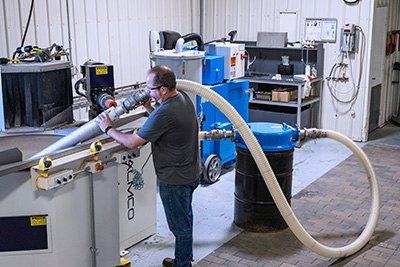
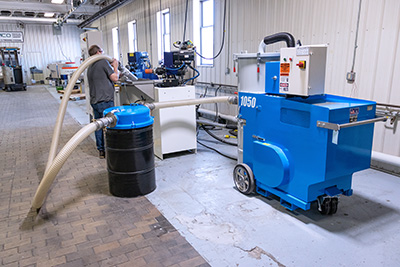
Common Applications for Material Handling Vacuum SystemsALMCO vacuum material handling systems solve specific production problems across finishing operations. Here’s where they most commonly fit: Evacuating Finishing Machines for Media ChangeWhen it’s time to swap media (running a different finishing process, replacing worn media, or switching part families), a vacuum loading system evacuates the machine in minutes. Media is transferred directly to a drum for disposal, a portable hopper for reuse, or a reclaim bin. This is one of the most common use cases, particularly in facilities running vibratory tubs, round bowls, and centrifugal barrel finishers with multiple media types. Automated Media Recovery LoopsIn integrated finishing cells: parts discharge from a finishing machine onto a screener that separates parts from media. The vacuum system then automatically transfers separated media back to a hopper or directly to the machine infeed for the next cycle. This closes the media loop without any manual intervention, a critical element of fully automated finishing systems. Routine Maintenance & CleanoutScheduled maintenance, seal replacements, and bowl inspections all require the machine to be emptied. Without a vacuum material handling system, that’s a labor-intensive manual task. With one, it’s a few minutes of operator time, maintenance stays on schedule instead of being deferred. Spent Media DisposalWhen media has reached the end of its useful life, it needs to be transferred to a disposal container. A vacuum system moves spent media directly into drums or containers for forklift removal, no operator exposure to dust, no dropped loads, no contaminated floor. Small Parts RecoveryIn some applications, vacuum systems can be used to recover small parts that have fallen into media beds, collected at discharge points, or been separated from finishing batches. Nozzles and filtration can be configured to capture parts without damage for inspection or reprocessing. |
How to Specify a Vacuum Loading System
ALMCO custom-engineers every vacuum material handling system around the specific machines, media types, and workflow of your facility. When you’re ready to specify a system, we’ll work through these factors together:
- 1. Media type and particle size: Ceramic, plastic, steel, synthetic, or mixed media. Large media requires different suction characteristics than fine abrasive powders. Media density, particle shape, and whether media is wet or dry all affect system design.
- 2. Source machine(s) and volume: Which finishing machines will the vacuum evacuate? Total media volume per cycle or per changeover determines required capacity and tank size. A system sized for a small vibratory bowl won’t keep up with a large vibratory tub or centrifugal barrel finisher.
- 3. Destination container or equipment: Fixed hopper for immediate return, portable drum for relocation, reclaim bin for storage, or disposal container? Destination affects hose length, ducting routing, and control integration.
- 4. Transfer distance and geometry: How far does the media need to travel? Are there elevation changes, tight bends, or obstructions in the path? Longer runs and more bends increase pressure loss and require larger vacuum capacity.
- 5. Production workflow integration: Will the vacuum system run standalone under operator control, or integrate with a PLC-controlled production cell? Automation level affects controls, sensors, and interlocks.
- 6. Environment: Wet or dry media handling, dust containment requirements, explosion-proof or intrinsically safe specifications (for certain metal dusts), and noise limits in the facility.
From there, ALMCO engineers design the system, vacuum capacity, filtration, nozzles, ducting, controls, and storage containers, and manufacture it at our facility in Albert Lea, Minnesota. For integrated finishing cells, vacuum system design is coordinated alongside conveyors, hoppers, and screeners so the complete material handling workflow is engineered as a unit.