
Large Part Deburring Machines: Sutton Centri-Flo Spindle Finishing Systems for Turbine Disks, Blisks, Impellers, and More
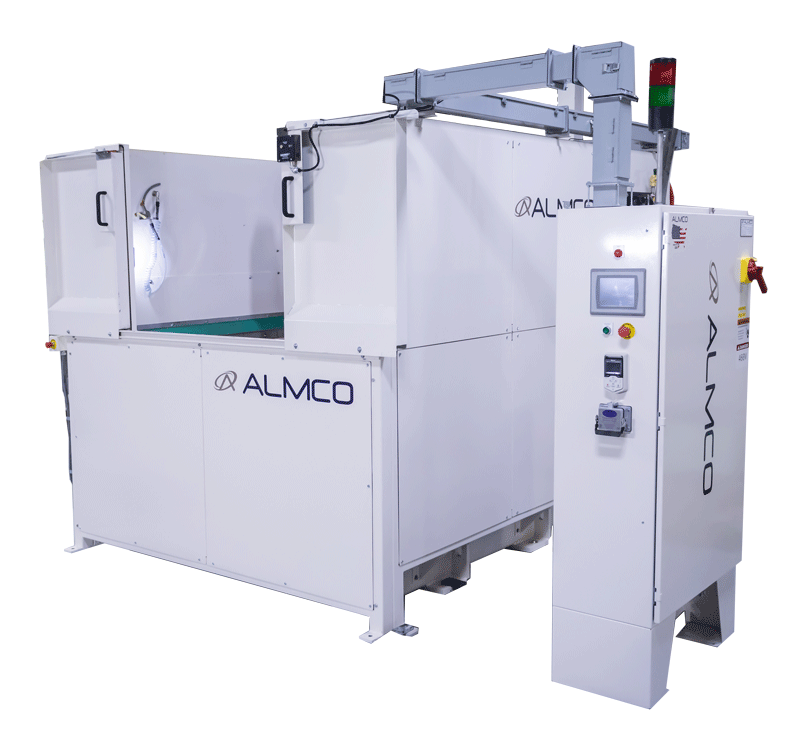
When parts exceed the size, weight, or geometric complexity that conventional vibratory finishing equipment can handle, hand finishing has traditionally been the only option—and it’s slow, inconsistent, and expensive. ALMCO’s Sutton Centri-Flo large part deburring machines eliminate that bottleneck. These heavy-duty spindle finishing systems are purpose-built for high-production deburring, edge blending, and surface refinement of large, complex components—including turbine disks, blades, blisks, impellers, and other rotational aerospace and industrial parts weighing hundreds of pounds and measuring up to 55” in diameter.
When to Specify a Large Part Deburring Machine
ALMCO Sutton machines are the right solution when your parts finishing challenge involves:
- Parts too large or heavy for vibratory tubs, bowls, or centrifugal barrel systems (up to 55” diameter, hundreds of pounds)
- Complex geometries with hard-to-reach internal passages, tight-radius features, or blade root forms
- Tight surface finish tolerances where part-to-part consistency is critical (e.g., aerospace turbine components)
- Long manual finishing cycle times that create labor cost and production bottlenecks
- Applications where hand finishing introduces variability that affects downstream assembly, balance, or performance
WHAT FINISHING EQUIPMENT IS RIGHT
FOR YOU?
Selecting the right industrial parts finishing equipment can be a complicated process. Explore the finishing options available with the industry with our white paper: What You Need To Know Before Buying Any Industrial Parts Finishing Equipment.
Quick Comparison: Sutton Large Deburring Machine Models
| Feature | CF Series | CFT Series | CFCA Series |
| Tub Motion | Rotates | Vibrates | Vibrates |
| Spindle Motion | Rotates (fixed angle) | Rotates (multi-axis, pendulum, reversible) | Oscillates (79° arc) |
| Aggressiveness | Highest | High | High |
| Best Geometry Access | External surfaces, blade profiles | Internal passages, cross-holes, blade roots | Deep valleys, undercuts, recessed features |
| Spindle Orientation | Parallel to tub bottom | Variable angle | Lowered into tub |
| Primary Applications | Turbine blades, similar-sized rotational parts | Turbine disks, blisks, impellers, complex parts | Large-diameter parts with deep recesses |
How Sutton Spindle Finishing Works for Large Part Deburring
In all three Sutton large part deburring machine configurations, the basic process is the same: a part is mounted on a spindle, lowered into a tub containing abrasive media and processing liquid, and then the spindle and/or tub move to create controlled contact between the media and the part surfaces. The specific combination of tub and spindle motion determines how aggressively the media attacks the part and which geometric features it can reach.
The Role of Media and Processing Liquid
As the media flows across part surfaces under the force of tub vibration, tub rotation, or spindle movement, it performs the same deburring and edge-blending action that occurs in vibratory finishing—but at much higher energy levels and directed specifically at the features of a single large part. The processing liquid (a mixture of water and finishing compound) washes away removed material, prevents redeposition, and controls the chemical environment of the process. Media selection (ceramic, plastic, or synthetic) is matched to the part material and the required surface finish outcome.
Advantages Over Hand Finishing
- Speed: Sutton large deburring machines finish parts in a fraction of the time required for manual deburring, directly reducing labor cost and cycle time per part.
- Consistency: Every part receives the same finishing process under the same controlled conditions, eliminating the operator-to-operator variability inherent in hand finishing.
- Access: Spindle motion forces media into internal passages, tight radii, blade root forms, and other hard-to-reach features that hand tools struggle to address uniformly.
- Repeatability: PLC-controlled cycles ensure the same spindle speed, angle, dwell time, and media conditions are applied to every part—critical for aerospace and other tightly toleranced applications.
Reduced Operator Fatigue and Risk: Eliminating manual deburring of heavy, complex parts reduces ergonomic strain and the risk of handling damage.
Industries That Rely on Large Part Deburring Machines
Aerospace & Gas Turbine Manufacturing
Sutton large deburring machines were originally developed for the aerospace industry and remain the standard for finishing turbine disks, blisks, turbine blades, and impellers used in jet engines and land-based gas turbines. These components demand precise edge radiusing, surface blending, and burr removal to meet strict aerospace finish specifications—processes that are impractical to achieve consistently by hand on parts of this size and complexity.
Power Generation
Large rotational components for steam turbines, industrial gas turbines, and power generation equipment require the same level of surface quality as aerospace parts—often at even larger diameters. Sutton large part deburring machines handle these oversized components with the heavy-duty construction and tub capacity required for continuous production.
Heavy Industrial & Defense
Beyond turbine components, Sutton machines are specified for any large manufactured part where manual finishing creates a production bottleneck—including pump impellers, large gear assemblies, defense system housings, and other critical components where finish consistency affects performance, balance, or fatigue life.
Why Engineers Specify ALMCO Sutton Large Deburring Machines
|