
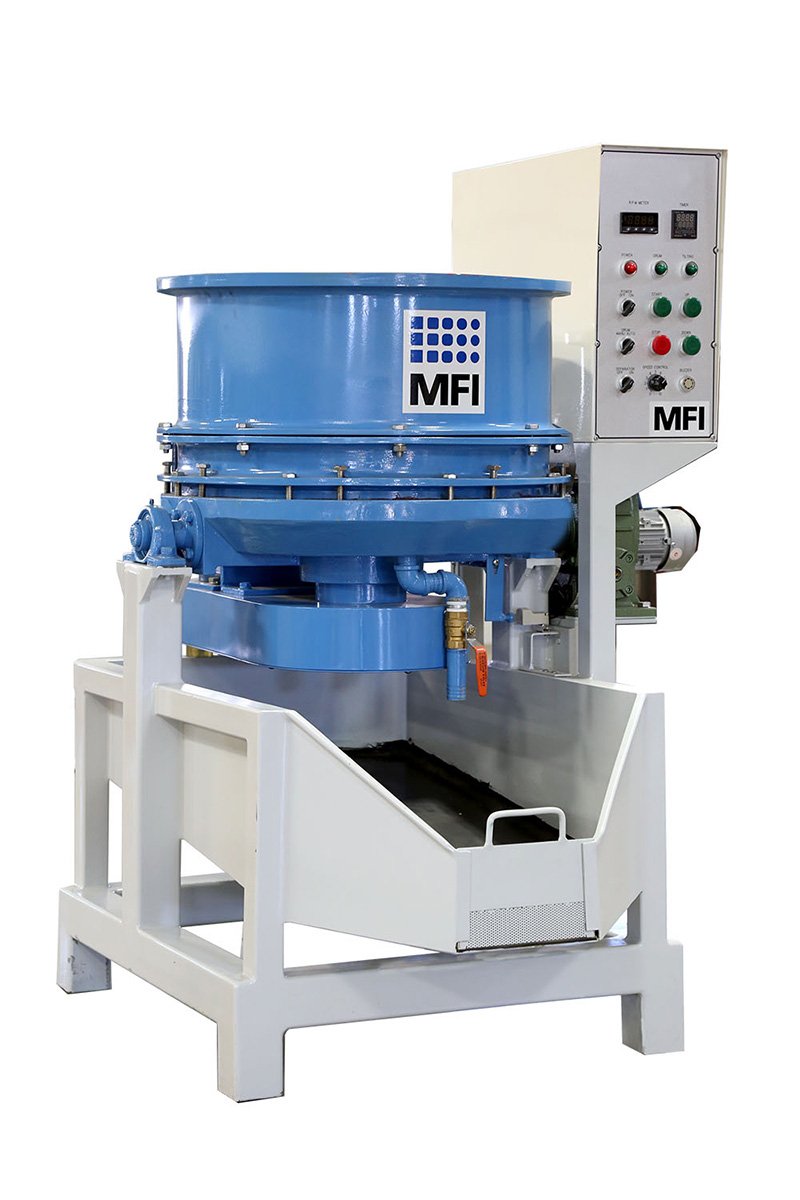
Centrifugal disc finishing machines are high energy disc finishers for deburring and polishing metal parts. Their open top loading and unloading features make them easy to automate into an inline production. 6 to 8 G-Force are produced by the disc spinning at the bottom of the bowl and moving against the stationary side walls. A powerful vortex is created at the bottom of the finishing chamber helping to achieve fast finishing results.
| Model No. | Working Capacity (Cu Ft.) | Tank Capacity (Liters) | Barrel Size (In) | Drive HP | Overall Dimensions (In) |
|---|---|---|---|---|---|
| RF-20 | .7 | 12 | 11 x 15 | 1 | 34 x 30 x 55 |
| RF-50 | 1.7 | 42 | 20 x 15 | 2 | 47 x 38 x 49 |
| RF-100 | 3 | 56 | 24 x 16 | 5 | 60 x 40 x 44 |
| RF-200 | 6 | 85 | 34 x 20 | 7.5 | 93 x 77 x 56 |
| RF-100A | 3 | 133 | 24 x 16 | 5 | 60 x 40 x 52 |
| RF-200A | 6 | 200 | 34 x 20 | 7.5 | 93 x 77 x 56 |
| RF-300A | 9.9 | 227 | 36 x 21 | 7.5 | 121 x 84 x 55 |
| RF-400A | 12.1 | 362 | 42 x 25 | 15 | 136 x 90 x 61 |
Mass Finishing Inc. Catalog

How Centrifugal Disc Finishing Works
In an RF Series centrifugal disc finisher, parts, finishing media, water, and compound are loaded into an open-top bowl with a polyurethane-lined interior. A high-speed rotating disc at the base of the bowl spins against the stationary sidewalls, propelling the mass of parts and media upward and outward in a continuous rolling, flowing pattern. This disc-driven motion generates 6–8 G-forces—far more energy than gravity-driven vibratory finishing—producing aggressive, uniform media contact across all part surfaces.
Variable Speed Process Control
Every RF Series disc deburring machine features a variable-speed drive, giving engineers precise control over the finishing intensity. Lower disc speeds produce gentler action suited for surface refinement, polishing, and processing delicate parts. Higher speeds deliver aggressive cutting for heavy deburring, edge radiusing, and deflashing. This adjustability allows a single centrifugal disc finisher to handle multiple finishing processes by simply changing the speed setting, media type, and compound chemistry.
Gap Adjustment for Part Protection
The twist gap adjustment method on RF Series machines allows operators to precisely set the clearance between the rotating disc and the stationary bowl wall. Proper gap adjustment prevents parts and media from entering the gap during processing—protecting both the parts and the polyurethane liner. This is a critical setup parameter, particularly when processing smaller parts or using fine media.
Open-Top Design for Easy Automation
Unlike centrifugal barrel finishers, which require barrel loading and unloading, centrifugal disc finishing equipment features an open-top bowl that accepts parts from above and discharges by tipping the tub. This design makes RF Series machines straightforward to integrate into automated inline production—parts can be fed from a hopper or conveyor, processed, and discharged to a separator or downstream washing station with minimal operator intervention.
Standard Features
- Variable Speed Drive: Adjust disc speed to match the aggressiveness of the finishing process—from gentle polishing to aggressive deburring—all on the same disc finishing equipment.
- Hot-Poured Polyurethane Liners: The bowl interior and disc surface are lined with durable, hot-poured polyurethane that withstands continuous high-energy operation and protects parts from metal-to-metal contact.
- Twist Gap Adjustment: Precisely set the clearance between the rotating disc and stationary bowl wall to prevent parts and media from entering the gap during processing.
- Flow-Through Drainage System: Continuous drainage removes spent compound and debris during processing, keeping the finishing environment clean and maintaining consistent process chemistry.
- Semi-Automated Unloading: A tipping mechanism allows the operator to discharge the entire bowl contents (parts and media) for separation, reducing manual handling between cycles.
- Process Cycle Timer: Set and repeat precise cycle times to ensure consistent finishing results from batch to batch.
Available Options
- Touchscreen HMI PLC Controls: Store and recall process recipes for different parts, automate multi-step finishing cycles, and monitor machine parameters. Upgrades the standard analog control panel to a touchscreen interface for increased automation and repeatability.
- Built-In Media and Parts Separation: Integrated separation system automatically sorts finished parts from media during discharge, reducing downtime between cycles and eliminating the need for a separate external screener.
- Wastewater Handling System: Manages process water discharge, supporting environmental compliance and simplifying facility plumbing requirements.
- Barrel Dividers: Create individual compartments within the bowl to prevent part-on-part contact during processing. Essential for delicate, cosmetically sensitive, or high-value components.
- Processing Station & Sludge Tank: Centralized compound dosing and sludge collection station for cleaner operation and simplified maintenance.
- Safety Light Curtains: Infrared light curtains disable all machine functions when the curtain is broken during loading or unloading, providing an additional layer of operator safety in automated environments.
- Fully Automated Systems (RF-A Models): The RF-100A, RF-200A, RF-300A, and RF-400A models add automated loading, weighing, finishing, separating, and washing processes controlled through PLC touchscreen—streamlining the entire finishing workflow for high-volume production.
Applications for Centrifugal Disc Finishing Equipment
RF Series centrifugal disc finishers handle a broad range of deburring and polishing applications across industries where fast cycle times, uniform results, and inline automation are priorities:
Deburring & Edge Radiusing
The primary application for disc deburring machines is removing burrs and radiusing edges on machined, stamped, die-cast, and forged parts. The high-energy disc action removes material quickly and uniformly—often achieving in 10–30 minutes what takes hours in a vibratory bowl or tub. Common applications include transmission gears, valve bodies, stamped brackets, and machined housings.
Surface Polishing & Refinement
By reducing disc speed and using finer media and polishing compounds, RF Series centrifugal disc finishers produce smooth, consistent surface finishes suited for cosmetic parts, pre-plating preparation, and friction reduction on drivetrain components. Variable speed control allows the same machine to perform aggressive deburring in one cycle and fine polishing in the next.
Deflashing
Centrifugal disc finishing equipment effectively removes flash from die-cast, injection-molded, and MIM (metal injection molded) parts. The high G-forces produced by the spinning disc break flash away cleanly without damaging part surfaces or fine features.
Descaling & Surface Preparation
Heat-treated, forged, or welded components often have surface scale that must be removed before downstream operations. RF Series disc deburring machines provide the aggressive action needed to strip scale efficiently while preparing the surface for coating, plating, or assembly.
Common industries:
- Automotive & transportation (gears, transmission components, stamped parts)
- Aerospace & defense (fasteners, structural components, precision machined parts)
- Medical device manufacturing (surgical instruments, device housings)
- General manufacturing & job shops (mixed-part environments, varied batch sizes)
- Firearms & munitions (precision deburring and polishing)
- Electronics & connectors (small stamped and machined contacts)
When to Choose Centrifugal Disc Finishing
Centrifugal disc finishers sit between vibratory finishing (lowest energy, longest cycle times) and centrifugal barrel finishing (highest energy, shortest cycle times for some applications). Understanding the tradeoffs helps engineers specify the right disc finishing equipment for their production context.
| Factor | Centrifugal Disc | Centrifugal Barrel | Vibratory (Tub/Bowl) |
| Finishing Speed | 10–30x faster than vibratory | Fastest (highest energy) | Baseline (hours per cycle) |
| Loading/Unloading | Open-top (easy automation) | Barrel loading (batch) | Open tub/bowl (batch or thru-feed) |
| Automation Suitability | Excellent—inline integration | Moderate—barrel swap required | Good—especially thru-feed tubs |
| Part Protection | Dividers available | Barrel dividers standard | Dividers on select bowls (OR Series) |
| Entry Cost | Lower than CBF | Higher | Lowest |
| Best For | Fast inline deburring/polishing, mixed processes, automation | Isotropic finish, highest speed, delicate part protection | General deburring, large parts, high-volume thru-feed |
| G-Forces | 6–8 G | Variable (centrifugal) | ~1 G (gravity + vibration) |
Choose a centrifugal disc finisher when: you need significantly faster cycle times than vibratory finishing, your production line benefits from open-top loading and inline automation, you want the flexibility to run both aggressive deburring and fine polishing on the same machine, or you’re looking for a practical, cost-effective step into high-energy finishing.
For applications requiring isotropic surface finish on high-value precision parts (medical implants, aerospace components), explore ALMCO’s centrifugal barrel finishers. For general-purpose deburring of larger parts or high-volume thru-feed processing, explore our vibratory tubs and vibratory round bowls.