
Parts Conveyors: Custom Part Conveyor Systems for Automated Finishing and Washing Lines
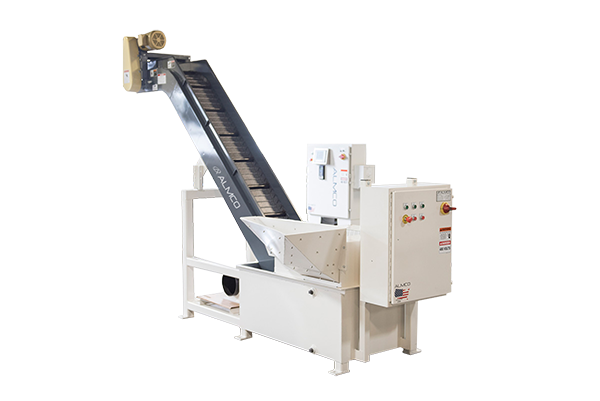
ALMCO parts conveyors transfer components between finishing machines, parts washers, and downstream operationsturning standalone equipment into integrated production cells. Every ALMCO part conveyor system is custom-engineered for the specific application, with belt type, frame dimensions, drive speed, and discharge geometry matched to your parts, throughput, and existing equipment layout. From a compact small parts conveyor feeding a vibratory bowl to a heavy-duty drag-out conveyor discharging finished parts from an inline washer, we design the conveyor around your production flownot around a standard catalog.
Part conveyor systems are the connective tissue of an automated finishing line. The right conveyor setup eliminates manual part transfers, prevents contamination between process stages, keeps cycle times consistent, and allows one operator to manage multiple machines. Because ALMCO engineers, manufactures, and installs both finishing equipment and parts conveyors under one roof, every integration detaildischarge height, parts orientation, flow rate, control interfaceis coordinated from the start. For the broader context on how conveyors fit into integrated systems, see our material handling overview.
See it Work with other ALMCO Equipment
Watch how our parts conveyors work integrate seamlessly into an automated system. The parts conveyor in the video is customized to carry the right amount of parts to the first stage of the system, an ALMCO inline washing unit.
Standard Features & Engineering Capabilities
Because every ALMCO part conveyor system is custom-designed for the application, features and configurations are selected to fit your specific production context. Standard engineering capabilities include:
Custom Belt Selection
ALMCO parts conveyors are built with the right belt material for the parts being transferred and the environment the conveyor operates inPVC for general part handling, stainless steel mesh for wet or contaminated environments, modular plastic for durability and easy maintenance, and specialty belts for high-temperature or chemically aggressive applications. Belt selection affects part stability, cleanliness, drainage, and long-term maintenance cost.
Heavy-Duty Frame Construction
Frames are built from painted mild steel or stainless steel depending on the application environment. Stainless steel is standard for conveyors operating in or near parts washers, immersion cleaners, or chemically exposed finishing lines. Heavy-duty frame construction supports the weight of loaded parts while resisting the corrosion and contamination common in industrial finishing environments.
Variable Frequency Drives (VFDs)
VFDs allow operators to adjust belt speed to match the cycle times of connected finishing or washing equipment. This is critical in integrated production cells where conveyors feed parts into a machine with a fixed processing ratematching conveyor speed to cycle time prevents pile-ups, missed loads, and cycle interruptions.
Integrated Safety Features
ALMCO part conveyor systems include standard safety guarding, emergency stop controls, and optional interlocked access panels. For fully automated cells, light curtains, two-hand controls, and safety-rated PLCs can be integrated to meet facility-specific safety protocols.
Sensors, Gates & Indexing
For automated production applications, parts conveyors can be equipped with photoelectric sensors to detect part presence and position, automated diverter gates to sort parts between finishing lines or reject stations, and indexing systems that position parts at precise intervals for robotic handling or fixture-based processing downstream.
Side Guards & Containment
Side guards prevent small parts from falling off the belt edge during transfer, particularly on incline or decline sections. Drainage pans, drip trays, and enclosed guarding are available for wet or messy applications where part carryover would contaminate the surrounding floor area.

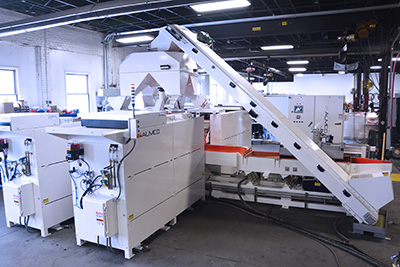
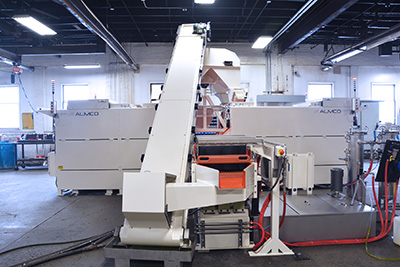
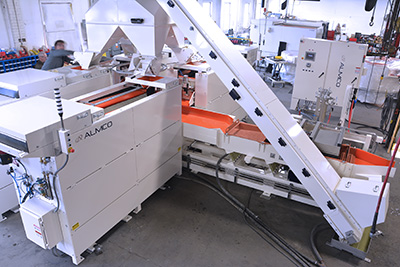
Parts Conveyor Configurations
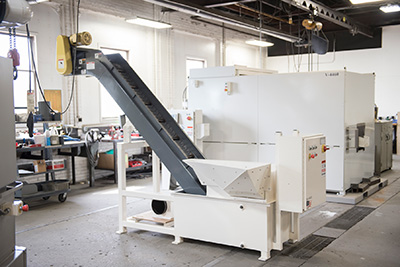
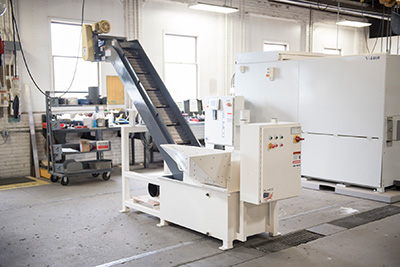
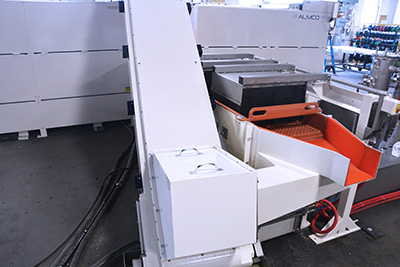
ALMCO designs parts conveyors in several geometry and belt configurations depending on how parts need to move between your equipment and what constraints your floor plan imposes.
Straight-Line Conveyors
The simplest and most common configuration. Straight-line parts conveyors move components horizontally between two machines at the same elevationfor example, from a vibratory finisher discharge to the infeed of a parts washer. These are ideal when floor space allows and machines are at compatible heights.
Incline Conveyors
When parts need to be lifted from a lower discharge point to an elevated infeed (for example, from a floor-level screener to the top-load opening of an overhead parts washer), an incline conveyor handles the elevation change. Cleated or ribbed belts prevent parts from sliding back on steeper inclines.
Decline Conveyors
Decline conveyors discharge parts from an elevated process into a lower-elevation machine, bin, or packing station. Common in finishing operations where parts exit a vibratory machine or centrifugal finisher above floor level and need to be delivered to a workstation or container at grade.
Drag-Out Conveyors
Drag-out conveyors are specifically engineered to pull parts out of a wet or immersion processtypically the discharge end of a conveyor parts washer or immersion cleaning system. Stainless steel construction, drainage features, and corrosion-resistant drive components are standard for these demanding environments. The drag-out conveyor is one of the most common conveyor types in finishing operations and often the critical link between wash and dry stages.
Small Parts Conveyor
For small, lightweight, or delicate components (stamped parts, electronic contacts, small machined pieces, medical device components), a small parts conveyor is engineered with fine-mesh or flat belts, narrow frames, and precise speed control. Side guards, containment lips, and low-profile designs keep small parts secure during transfer.
Cleated & Magnetic Belts
Cleated belts incorporate ribs or cleats across the belt surface to prevent parts from slidingessential for inclines, delicate positioning, or parts with odd geometries. Magnetic conveyors use belt-embedded magnets to hold ferrous parts in place during transfer, useful for vertical lifts, high-speed transfers, or applications where part orientation matters.
Where Parts Conveyors Fit in a Finishing OperationParts conveyors are rarely the primary piece of equipment in a finishing operationbut they’re almost always the difference between a batch process and an automated production line. Here’s where ALMCO part conveyor systems most commonly fit: Feeding Parts Into Finishing MachinesA hopper stages bulk parts at floor level; a parts conveyor meters them into the finishing machine at a controlled rate. This setup transforms vibratory tubs, round bowls, and centrifugal finishers from operator-dependent batch machines into automated stations where a single operator can monitor several lines. Discharging Parts From Finishing to WashingThis is the classic integrated finishing cell application: a finishing machine discharges parts onto a screener, then a parts conveyor transfers separated parts directly into a conveyor parts washer or cabinet spray washer. Eliminates the operator step of moving parts between stages, prevents contamination, and keeps both machines running at full throughput. Multi-Stage Finishing LinesWhen parts need to go through multiple finishing stages (coarse deburring, then fine finishing, then polishing, for example), parts conveyors move parts between stages without batch interruption. Indexing and gating features can route different parts through different process paths in the same line. Post-Wash Drag-Out and Inspection DeliveryA drag-out conveyor pulls parts from a wet washer or immersion system, delivers them through a dryer tunnel (or onto a drying station), and presents them on an inspection or packing lineoften with timed indexing so operators see parts at a consistent cadence. Connecting Upstream Machining to FinishingParts conveyors can bridge CNC machining, stamping, or other upstream operations directly into ALMCO finishing systemseliminating batch staging, reducing WIP inventory, and keeping parts flowing through the entire production process without manual handling. |
How ALMCO Engineers a Custom Parts ConveyorEvery ALMCO part conveyor system is designed around your specific parts, existing equipment, and production workflow. When you’re ready to specify a conveyor, we’ll work through the following factors together: 1. Parts being transferred: Size, weight, geometry, material, temperature, and whether they’re wet, oily, or contaminated at the transfer point. Small parts conveyor applications require different belt and frame decisions than heavy-duty drag-out conveyors for castings or forgings. 2. Source and destination equipment: What machines does the conveyor connect to? Discharge height, infeed height, discharge geometry, and control interface all drive conveyor design. ALMCO equipment is the easiest integration case, but we regularly design conveyors that interface with third-party machines. 3. Throughput rate: Parts per minute or parts per hour. This determines belt speed, width, and loading geometry. Matching conveyor throughput to the cycle time of connected machines is critical to avoid pile-ups or starved infeeds. 4. Floor plan and elevation changes: Available floor space, elevation changes between source and destination, overhead obstructions, and aisle clearance requirements. This drives straight-line vs. incline vs. decline configuration. 5. Environment: Wet, dry, high-temperature, chemical exposure, or food-grade requirements. Determines frame material, belt type, drive protection, and corrosion resistance specifications. 6. Automation and control integration: Standalone or integrated into a larger PLC-controlled cell? Sensor requirements, safety protocols, and interlock interfaces with connected equipment. From there, ALMCO engineers design the conveyor, provide drawings for your review, manufacture the unit in Albert Lea, Minnesota, and support installation and startup. For multi-component finishing lines, our engineers coordinate conveyor design alongside finishing machine and washer design so the complete system is engineered as a unitnot assembled from components. |