
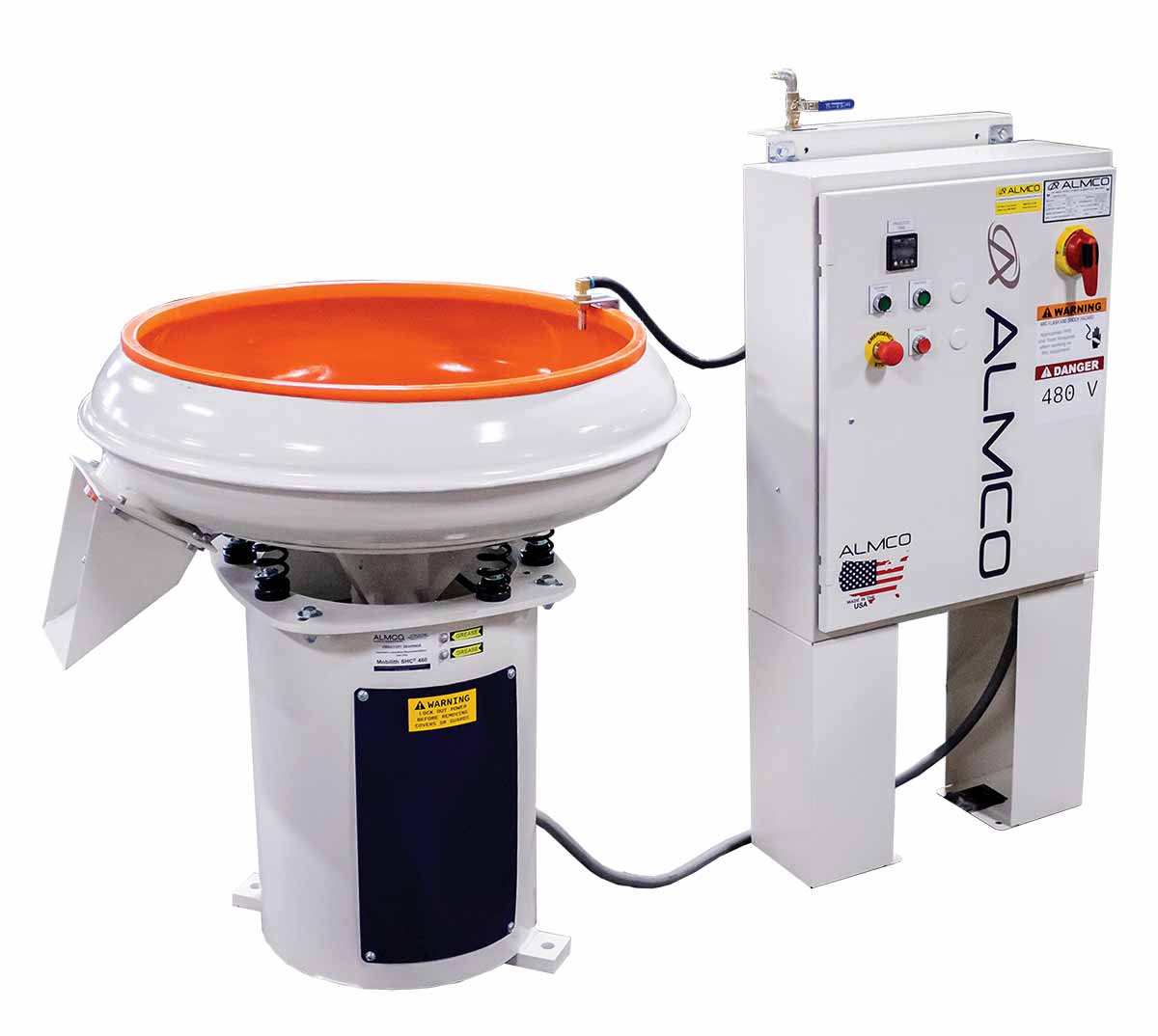
The OR-3 Vibratory Bowl brings ALMCO’s proven OR-Series design to a compact 3 cubic foot capacity. The OR series continues to be a popular choice because it delivers consistent finishg results, dependable operation and long service life.
Vibratory Finishing Equipment
OR-3 VIBRATORY BOWL
OVERVIEW
OR-3 SYSTEM OVERVIEW
The OR-3 is the smallest model in ALMCO’s established OR-Series family, offering 3 cubic feet of processing capacity in a compact, production-proven design. As part of a vibratory bowl line trusted by manufacturers for decades, the OR-3 delivers the reliability, durability, and consistent finishing performance that have made the OR Series a longstanding industry favorite.
While manufacturing technologies continue to evolve, the OR design has remained a preferred solution because it simply works. Its straightforward, robust construction and dependable vibratory action provide consistent deburring, edge radiusing, cleaning, burnishing, and surface finishing across a wide range of applications and materials.
The OR-3 is particularly well suited for machine shops, metal stampers, precision manufacturers, and other operations processing small to medium-sized components. Its compact footprint makes it an excellent choice where floor space is limited, while still providing the production capability needed for daily manufacturing demands.
For manufacturers seeking a finishing system with a long track record of success, the OR-3 offers the confidence that comes from a design proven in thousands of production environments.
KEY ADVANTAGES
- Compact 3 ft³ capacity for efficient processing in limited floor space
- Proven OR-Series design trusted in production environments for decades
- Compatible with compartment dividers for part separation and damage reduction
- Quickly load and unload parts by hand and observe process in compact space
COMMON APPLICATIONS
- Small CNC machined components
- Medical and precision-manufactured parts
- Short-run and job shop production
- Deburring, edge radiusing, cleaning, and surface refinement of small-to-medium parts
TECHNICAL SPECIFICATIONS
| Specification | Value |
|---|---|
| Length | 54″ (approx. overall, including free-standing main electrical enclosure) |
| Width | 36″ (approx.) |
| Height | 40″ (approx.) |
| Bowl Outside Diameter | 33″ |
| Bowl Cross Section | 8-1/4″ Diameter |
| Discharge Height | 22″ (approx.) |
| Bowl Working Capacity | 3 Cubic Feet |
| Bowl Lining | 3/8″ Thick Polyurethane, 90 Durometer |
| Product Load Height | 40″ |
| Voltage | 230 or 460 Volts, 3 phase, 60 Hz |
| Electrical Enclosure | Free-standing Hoffman (or Saginaw) NEMA 12 enclosure |
| Motor | 2 HP, 1750 RPM three-phase electric |
| Drive | AC variable frequency drive |
SYSTEM DETAILS
- Divider Option
- Urethane Lined Process Bowl
- Spray System
- How it Works
- Drive Unit
- Electrical Controls
- Machine Base
OR Series Divided
Divider Option
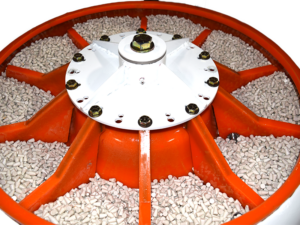
This feature creates equally spaced compartments within the processing bowl, which keep vibrating parts from contacting each other during the deburring process. The Divider Assembly consists of a polyurethane-lined dome that mounts in the middle of the bowl, a rotating framework (or “carousel”) that mounts to the dome, and a number of molded polyurethane dividers bolted to the carousel. The entire assembly mounts on two heavy duty bearings that allow the vibrating media within the bowl “push” on the dividers, causing the carousel to rotate along with the media as it progresses around the processing bowl.
OR-3 Bowl
Urethane Lined Process Bowl
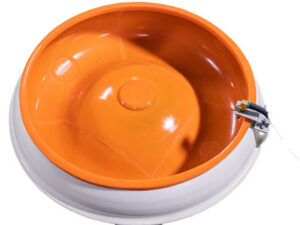
The machine’s processing bowl consists of a weldment fabricated from two spun-metal sections and a rigid vibrator mounting plate. The bowl rests on machine base springs, and during operation these springs allow the bowl to rapidly “wobble” as the center-mounted vibrator spins. This vibrating action of the bowl imparts energy to the process parts and abrasive media within the bowl, causing the parts to be deburred by the media.
The 3 cubic foot processing bowl (or “tub”) is a gusseted, circular weldment. The interior of the bowl weldment has a U-shaped cross section that is lined throughout with 3/8″ thick cast polyurethane to provide a smooth interior with no seams, crevices or ridges for parts to hang up within the bowl.
OR Spray System
Spray System
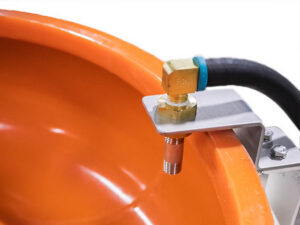
The machine is equipped with a spray system designed to inject water (and/or liquid compound) into the processing bowl to keep the finishing media clean and free cutting by flushing fines and other contaminants out of the bowl through a perforated (replaceable) molded drain plate in the bottom of the bowl.
OR How it Works
How it Works
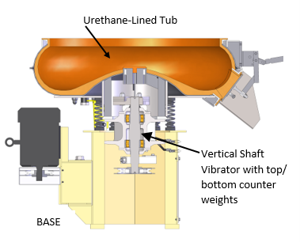
The vibrating motion of the machine’s spring-mounted processing bowl is generated by the bowl vibrator assembly. This unit consists of a vertical shaft having a counterweight mounted on each end, with the shaft turning in a pair of spherical roller bearings pressed into precision-machined housings. The vibrator assembly is bolted to the bowl such that the vertical shaft runs down through the hollow center of the bowl, extending beneath the bowl within the machine base.
In operation, the out-of-phase counterweights on the spinning vibrator shaft create an imbalance that causes the spring-mounted processing bowl to rapidly “wobble” on its springs. This vibrating action in turn causes the mass of parts and media within the bowl to vibrate, roll, and progress around the bowl in an orderly fashion. The “action” (roll and progression) of parts and media within the bowl can be controlled by adjusting the speed of the vibrator shaft, changing the amount of upper and/or lower counterweight, and also by changing the angular relation between the upper and lower counterweights.
Drive Unit
The vibrator assembly is driven by a 7-1/2 HP, 1800 RPM TEFC electric motor powered by an AC variable frequency drive. The motor mounts to the machine base, and the drive sheave on the motor is connected by V-belt to a companion sheave on the vibrator assembly. Frequency of vibration is variable and can be adjusted between from 800 to 1400 cycles per minute by turning a potentiometer dial located on the main electrical enclosure.
OR Control Panel
Electrical Controls
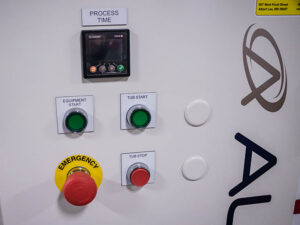
Electrical controls are housed in a free-standing enclosure. Components within the enclosure are finger-safe and are Allen-Bradley brand unless noted otherwise. Components include a main disconnect switch, fuse holders and branch circuit fuses (as needed), Panduit wireways, terminal strips, a G.E. 115 Volt control circuit transformer, master control relay, and a PowerFlex variable frequency drive.
All other process control pushbuttons and indicating lights are mounted on the front door of the main electrical enclosure. Buttons and lights are Allen-Bradley brand. The machine is wired in accordance with NEC (NFPA 70) and NFPA 79 standards, ready for connection to your electrical service.
Machine Base
- The machine base is a cylindrical weldment fabricated of a rigid 3/16″ thick rolled steel. The top of the base includes a flat ring-shaped plate used to mount six coil-wound springs that support the machine’s processing bowl. The bottom of the base includes a motor mount and four floor pads used to secure the machine in place. A hinged inspection door provides access to the bowl drive and to the lower portion of the vibrator assembly.
FREQUENTLY ASKED QUESTIONS
What materials can the machine process?
Vibratory bowl tumblers are commonly used for:
- Steel and stainless steel
- Aluminum
- Brass and copper
- Zinc die-cast parts
- Plastic components
They are typically used for deburring, polishing, burnishing, cleaning, descaling, and edge radiusing.
What machine size do I need?
Machine size depends on:
- Part dimensions
- Batch volume
- Daily production requirements
- Required cycle time
ALMCO technicians will help you calculate capacity based on part volume, media-to-part ratio, and desired throughput.
What finish can I achieve?
Typical finishing objectives include:
- Deburring
- Surface smoothing
- Edge radiusing
- Satin finishing
- Bright polishing
- Burnishing
- Pre-paint or pre-plating preparation
The final finish depends on the machine, media, compound, and cycle time.
Which media should I use?
Common media options include:
- Ceramic media – aggressive deburring and polishing
- Plastic media – suitable for softer metals and delicate parts
- Steel media – burnishing and bright finishing
- Organic media (corn cob, walnut shell) – drying and final polishing
Media selection is one of the most important factors affecting performance and finish quality. ALMCO technicians will help you determine the best media for your application.
Can one machine handle multiple part types?
Yes, you can utilize different media and parts in the same bowl. Different parts and materials may require different size and shaped media depending on their outside geometry. If the same media works for multiple size components then you can run them consecutively.
Does it come with sound-dampening features?
The sound level is highly dependent on the type of tumbling media and the parts running in the tub. ALMCO offers an integrated acoustic sound lid to help dampen the noise. Some customers choose to build an insulated room around the tub to further eliminate sound.
What operating costs should I expect?
Cost of ownership includes
- Replenishing the media as it wears down in size
- Cleaning compounds
- Water consumption
- Electricity to run the machine motors depending on the amperage
- Maintenance and spare parts
Media consumption and compound usage often represent the largest recurring expenses.
Is automatic separation available?
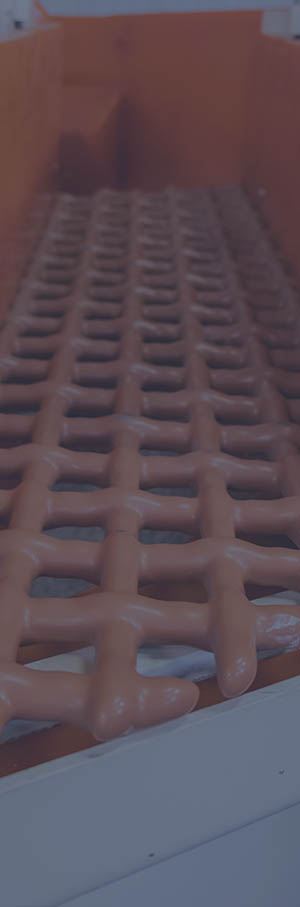
A key feature of vibratory bowls is their ability for internal separation. The SBB-8s spiral bottom design allows media and parts to flow easily around the processing channel and up to the separation screen deck when a gate is engaged.
The SBB line can be equipped with:
- Pneumatic gate
- A gate clearing sequence that runs the machine in reverse
- Automated timers and automatic speed adjustment to slow down the process as parts leave the machine.
These features reduce labor and improve production efficiency.
Should I choose a vibratory bowl or a vibratory tub?
Vibratory bowls are best for:
• Parts smaller than six inches in diameter
• High-volume batch production
• Automatic media separation
A vibratory tub is usually preferred for:
• Long parts
• Larger parts that require separation using dividers
• Heavy components
• Parts that could become damaged in a bowl’s circular action
What are the questions I need to answer before buying an ALMCO machine?
- What is my daily production volume?
- What finish do I need?
- What are my part dimensions and material?
- Which media will be required?
- Do I need wet or dry processing?
- Do I need automatic separation?
- What is my budget for both equipment and consumables?
- How much floor space is available?
- What level of automation do I require?
- What ROI or throughput improvement am I expecting?
These are the questions most industrial buyers ask when evaluating ALMCO vibratory bowl and other finishing equipment.
What cycle time should I expect?
Cycle times are dependent on:
- The surface hardness of the material
- Starting surface roughness of the part
- Burr type
- Surface finish requirements
- Media type
Some cleaning applications or very light edge break may be accomplishing in one pass through the bowl. Heavy deburring or polishing applications can require several hours.
OPTIONS & UPGRADES
Sound Hood
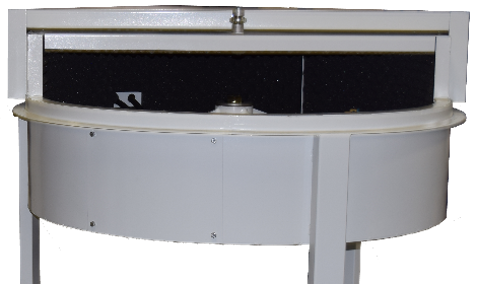
The integrated sound hood helps reduce the noise level of the machine. The metal revolving door and frame are lined with acoustic foam to dampen vibration noise.
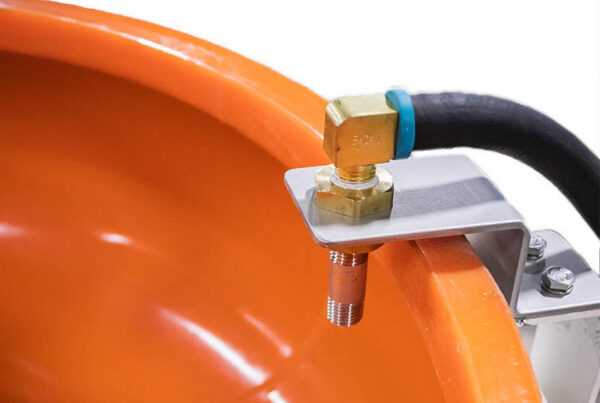
Compound Dosing
ALMCO offers flexible options for delivering compound to your process. These include both machine and wall mounted systems.
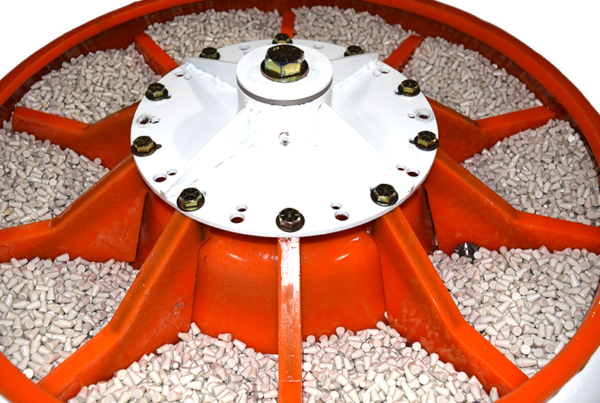
Rotating Dividers
Creates equally spaced compartments within the processing bowl to keep parts separated during tumbling. The whole assembly is designed to rotate with the motion of the media during the process.
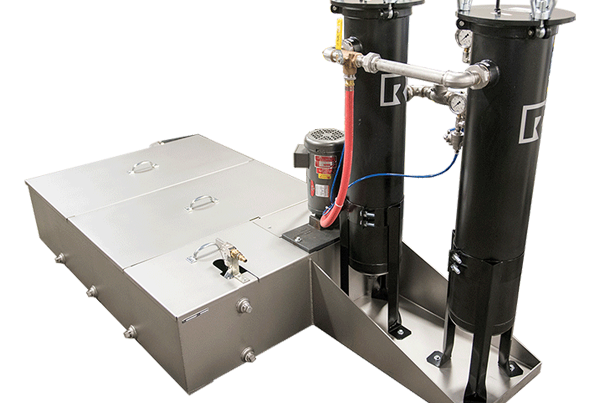
Water Recycling
Depending on your application, ALMCO offers a variety of solutions to treat the waste water generated during the tumbling process.
Thru-Feed Model Comparison
| Spec | OR-3 | OR-5 | OR-10 |
|---|---|---|---|
| Working Capacity | 2.4 | 4.5 | 8.1 |
| Motor Size | 2 | 3 | 5 |
| Overall Dimensions (In) | 53 x 36 x 40 | 57 x 45 x 40 | 48.5 x 48.5 x 42.5 |
| Channel Cross Section | 8.25″ | 10″ | 12″ |
| Power Consumption at 480v, 3 Phase (amps) | 2.5 | 3.75 | 6.25 |
| Ceramic Media Required (lbs) | 228 | 427.5 | 769.5 |
| Steel Media Required (lbs) | 720 | 1350 | 2430 |
| Plastic Media Required (lbs) | 156 | 292.5 | 526.5 |
| Maximum Part Size | 5″ Diameter | 7″ Diameter | 9″ Diameter |
REQUEST A QUOTE
Let’s talk about the right equipment for your operation.
Tell us about your parts and process. Our team will follow up to discuss the equipment and your application.