
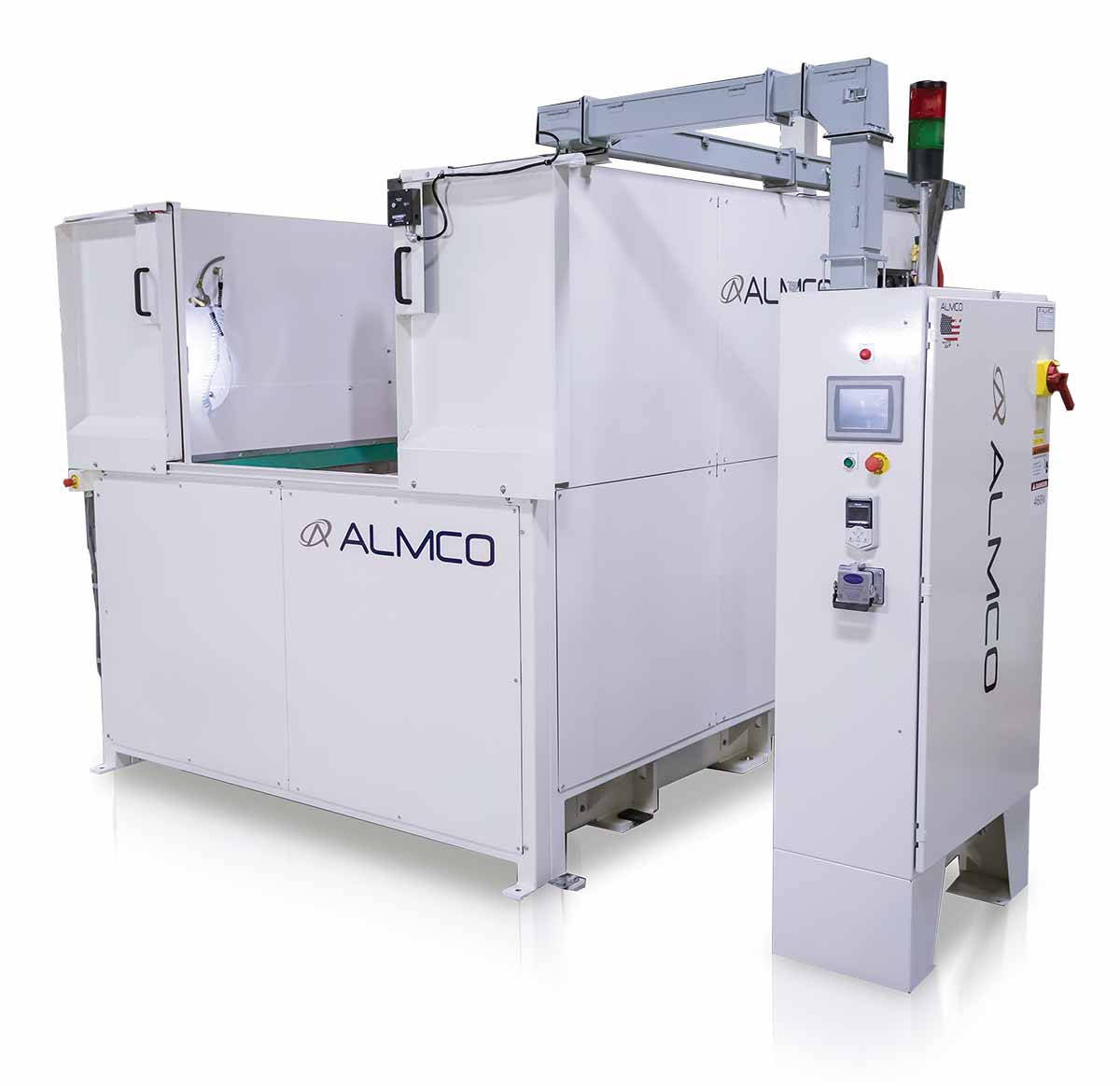
The Sutton CFT-3000 is a high-energy spindle finishing system engineered for deburring, edge blending, and surface refinement of rotational components up to 40 inches in diameter. With spindle speeds up to 900 RPM, the CFT-3000 delivers aggressive finishing action and exceptional process consistency for aerospace, turbine, and precision-machined parts requiring efficient surface improvement and edge conditioning.
Sutton-Spindle Series
CFT-3000 Centri-Flo® Tornado Finishing System
OVERVIEW
CFT-3000 System Overview
The CFT-3000 combines Sutton’s proven Centri-Flo® spindle finishing technology with a high-speed spindle system capable of operating up to 900 RPM. Designed for parts up to 40 inches in diameter and 12 inches thick, the machine is ideally suited for manufacturers seeking faster cutting action, consistent edge blending, and repeatable surface finishing results.
Unlike traditional mass-finishing systems, the workpiece is securely mounted to a rotating spindle and moved through a vibratory media bed. During processing, the spindle can be positioned at multiple angles, oscillate through the media in a pendulum-like motion, and reverse rotation direction automatically. This controlled motion actively drives media and compound through complex features, pockets, slots, blade forms, and machined surfaces to improve finishing uniformity across the entire component.
The higher spindle speed range allows the CFT-3000 to generate aggressive media interaction, making it particularly effective for removing machining marks, blending edges, and refining surfaces on precision-manufactured components.
For aerospace, power generation, and advanced manufacturing applications requiring efficient processing and consistent results, the CFT-3000 provides a highly repeatable alternative to labor-intensive hand finishing operations.
KEY ADVANTAGES
- Spindle speeds up to 900 RPM for aggressive finishing action
- Processes parts up to 40″ diameter and 12″ thick
- Excellent edge blending and surface refinement capability
- Reduces manual finishing labor and process variability
COMMON APPLICATIONS
- Blisks and compressor wheels
- Aerospace machined components
- Impellers
- Additively manufactured metal parts
- Precision turbine hardware
- Complex CNC-machined rotational components

TECHNICAL SPECIFICATIONS
| Spec | Value |
|---|---|
| Length | 120″ (approx., front to rear) |
| Width | 100″ (approx., less free-standing main electrical enclosure) |
| Height | 100″ (approx. highest point with spindle in down position) |
| Number of Spindles | 1 |
| Part Size Range | Up to 40″ Dia. by 12″ thick |
| Process Tub Size | 59″ x 52″ x 30″ (approx. 41 ft³) |
| Process Tub Vibrator Speed | 1,300 RPM (approx.) |
| Spindle Speed Range | 150-900 RPM (75-450 RPM in High-Torque Version) |
| Drive HP | 50 |
| Machine Weight | 15,800 lbs. (estimated, empty) |
| Vibratory Tub Motor | 10 HP, 1750 RPM |
| Electrical Panel | NEMA 12 enclosure |
SYSTEM DETAILS
- Vibrating Process Tub
- Safety Shroud
- Spindle Assembly
- How it Works
- Drive Unit
- Electrical Controls
- Machine Base
- Spindle Support
Process Tub
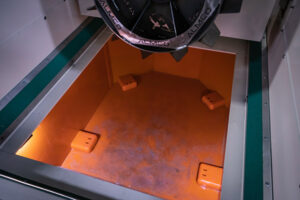
Vibrating Process Tub
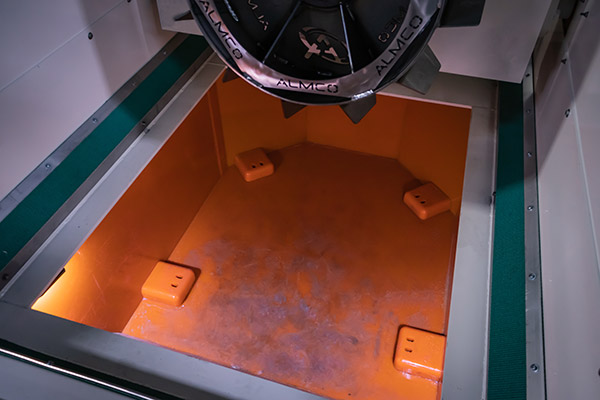
The processing tub measures approximately 52″ wide by 76” long by 30” deep and is fabricated from 1/2” mild steel plate using all-welded construction. The tub bottom is reinforced with 1/2” plate steel gussets, and the rear of the tub includes mounting structure for the tub vibrator assembly. The interior of the process tub is lined with polyurethane to protect the tub weldment from the abrasive media.
The tub is mounted on heavy coil springs that allow the tub to move as is vibrates. Vibrating motion of the tub is generated by the vibrator assembly, which consists of a horizontal shaft having a counterweight mounted on each end, with the shaft turning in a pair of spherical roller bearings pressed into precision-machined housings. The vibrator assembly is bolted to the rear of the tub so that the shaft runs parallel with the tub’s width, and the vibrator is V-belt driven at approximately 1,300 RPM by a 10 HP 1750 RPM electric motor mounted to the machine base.
The processing tub also includes built-in plumbing and an overflow drain fitting that allows water and/or liquid compound to be continuously added into the tub to enhance the cutting action of the abrasive media. Compound is delivered to the tub by an external compound supply system such as an (optional) ST-4 tank and pump, or a Dosatron compound metering system.
Safety Shroud
Safety Shroud
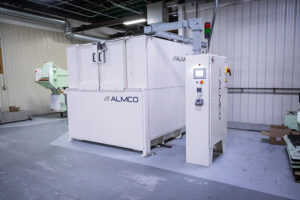
Located around the perimeter of the base/frame weldment is the machine’s free-standing shroud. This 10 gauge mild steel structure measures approximately 90” tall and acts as a safety barrier on the sides and rear of the machine. The top of the shroud is open to the room, and the inside walls of the shroud are lined with 3” thick sound-absorbing foam insulation for noise reduction. The front portion of the shroud is open, allowing access to the processing tub and spindle for loading and unloading of process parts. This “work zone” includes sliding safety door equipped with interlocking safety switches to prevent the machine from running when the doors are open.
Spindle Assembly
Spindle Assembly
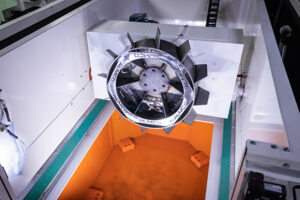
The spindle assembly consists of a 1” thick, box-shaped housing that has a 3” diameter pivot shaft extending out each side (these shafts are supported by the previously-described pillow block bearings mounted on the machine frame). The housing is machined for mounting the spindle drive motor and two spindle support bearings, and the inside of the housing includes a heavy-duty belt drive that connects the motor shaft to the spindle shaft.
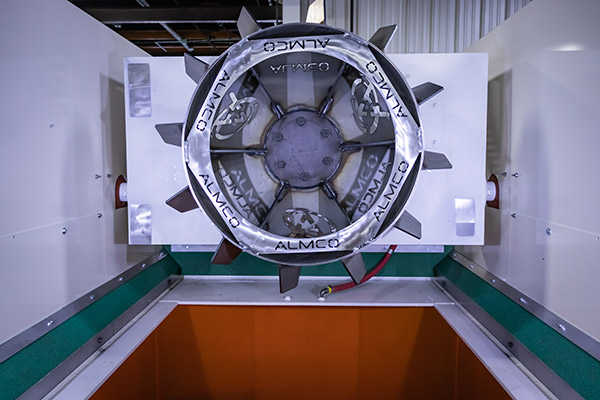
The forward-facing end of the spindle shaft is fitted with a flanged adaptor plate designed to accept part-holding tooling (quoted separately). The tooling is actuated by air pressure through an 8” diameter by 2” stroke air cylinder and draw rod located at the opposite end of the spindle shaft.
The spindle assembly is driven by 50 HP AC motor mounted to the spindle housing and powered through a variable frequency drive.
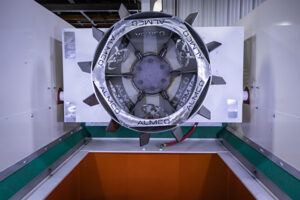
Sutton Sample Part
How it Works
The Sutton Centri-Flo Tornado (CFT Series) finishes parts primarily through the movement of the spindle. In the CFT Series, the spindle does all the work, and the part rotates at a high speed and at various angles within the tub of vibrating media. In addition to having the ability to position the spindle in various angles within the tub, it also can swing back and forth through the media as the spindle rotates – similar to the motion of a pendulum. It also has the ability to stop mid-cycle and change rotation direction. This motion allows the media and processing liquid to flow through the part’s features to deburr the edges and blend surfaces.
Drive Unit
The spindle assembly is driven by 50 HP AC motor mounted to the spindle housing and powered through a variable frequency drive.
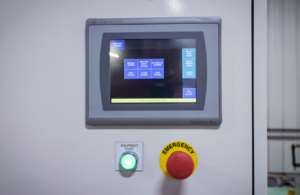
Sutton Controls
Electrical Controls
Electrical controls are housed in a free-standing NEMA 12 enclosure. All components within the enclosure are finger-safe and are Allen-Bradley brand unless noted otherwise. Components include a main disconnect switch, power distribution block, Littelfuse fuse holders and branch circuit fuses, Taylor wireways, terminal strips, a power supply to provide a 24 Volt DC control circuit, master control relay, a G.E. (or equal) transformer to provide 115 Volt single phase power (as needed), a CompactLogix programmable logic controller (PLC), a Phoenix Contact communication module (for remote access by ALMCO to the PLC for troubleshooting, program changes, etc.), a PowerFlex variable frequency drive, and motor circuit protectors with thermal overloads and short circuit protection.
Equipment Power On and Emergency Stop pushbuttons, along with an Allen-Bradley PanelView Plus 7” color touch screen are provided on the front and/or side of the machine electrical enclosure. The touch screen includes all machine controls and is used to display system messages and to enter values for processing parameters. A multi-color stack light is provided on top of the electrical enclosure to indicate machine status, and remote Emergency Stop pushbuttons are provided at key points out on the machine. Buttons and lights are Allen-Bradley brand.
All electrical components are UL listed and the machine is wired in accordance with NEC (NFPA 70) and NFPA 79 standards, ready for connection to your electrical service.
Machine Base
The Deburring Machine’s base/frame weldment is fabricated from heavy-wall structural steel tubing gusseted with plate steel to provide a rigid assembly capable of maintaining positive alignment of the machine’s moving parts. Extending upward from the base is a structural steel frame used for mounting the coil springs that support the vibrating processing tub.
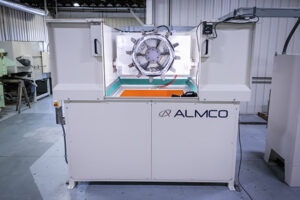
Spindle Support
Spindle Support
The machine frame also includes the spindle support structure, which includes two 3” pillow block bearings that hold each end of the spindle housing pivot shaft. Automatic tilting of the spindle down into and up out of the process tub is accomplished via two 6″ diameter air cylinders mounted to the machine frame and connected to the spindle pivot shaft via welded steel lever arms. Spindle tilting angle is adjustable through approximately 100 degrees via the electrical system’s operator touch screen.
FREQUENTLY ASKED QUESTIONS
What materials can the machine process?
Vibratory bowl tumblers are commonly used for:
- Steel and stainless steel
- Aluminum
- Brass and copper
- Zinc die-cast parts
- Plastic components
They are typically used for deburring, polishing, burnishing, cleaning, descaling, and edge radiusing.
What machine size do I need?
Machine size depends on:
- Part dimensions
- Batch volume
- Daily production requirements
- Required cycle time
ALMCO technicians will help you calculate capacity based on part volume, media-to-part ratio, and desired throughput.
What finish can I achieve?
Typical finishing objectives include:
- Deburring
- Surface smoothing
- Edge radiusing
- Satin finishing
- Bright polishing
- Burnishing
- Pre-paint or pre-plating preparation
The final finish depends on the machine, media, compound, and cycle time.
Which media should I use?
Common media options include:
- Ceramic media – aggressive deburring and polishing
- Plastic media – suitable for softer metals and delicate parts
- Steel media – burnishing and bright finishing
- Organic media (corn cob, walnut shell) – drying and final polishing
Media selection is one of the most important factors affecting performance and finish quality. ALMCO technicians will help you determine the best media for your application.
Can one machine handle multiple part types?
Yes, you can utilize different media and parts in the same bowl. Different parts and materials may require different size and shaped media depending on their outside geometry. If the same media works for multiple size components then you can run them consecutively.
Does it come with sound-dampening features?
The sound level is highly dependent on the type of tumbling media and the parts running in the tub. ALMCO offers an integrated acoustic sound lid to help dampen the noise. Some customers choose to build an insulated room around the tub to further eliminate sound.
What operating costs should I expect?
Cost of ownership includes
- Replenishing the media as it wears down in size
- Cleaning compounds
- Water consumption
- Electricity to run the machine motors depending on the amperage
- Maintenance and spare parts
Media consumption and compound usage often represent the largest recurring expenses.
Is automatic separation available?
A key feature of vibratory bowls is their ability for internal separation. The SBB-8s spiral bottom design allows media and parts to flow easily around the processing channel and up to the separation screen deck when a gate is engaged.
The SBB line can be equipped with:
- Pneumatic gate
- A gate clearing sequence that runs the machine in reverse
- Automated timers and automatic speed adjustment to slow down the process as parts leave the machine.
These features reduce labor and improve production efficiency.
Should I choose a vibratory bowl or a vibratory tub?
Vibratory bowls are best for:
• Parts smaller than six inches in diameter
• High-volume batch production
• Automatic media separation
A vibratory tub is usually preferred for:
• Long parts
• Larger parts that require separation using dividers
• Heavy components
• Parts that could become damaged in a bowl’s circular action
What are the questions I need to answer before buying an ALMCO machine?
- What is my daily production volume?
- What finish do I need?
- What are my part dimensions and material?
- Which media will be required?
- Do I need wet or dry processing?
- Do I need automatic separation?
- What is my budget for both equipment and consumables?
- How much floor space is available?
- What level of automation do I require?
- What ROI or throughput improvement am I expecting?
These are the questions most industrial buyers ask when evaluating ALMCO vibratory bowl and other finishing equipment.
What cycle time should I expect?
Cycle times are dependent on:
- The surface hardness of the material
- Starting surface roughness of the part
- Burr type
- Surface finish requirements
- Media type
Some cleaning applications or very light edge break may be accomplishing in one pass through the bowl. Heavy deburring or polishing applications can require several hours.
OPTIONS & UPGRADES
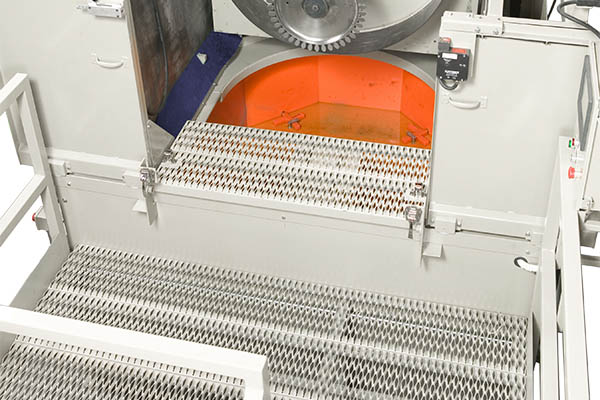
Flexible Layout
ALMCO can work with your team to meet the needs of your facility. This includes custom work platforms and positioning of the control panel.
Compound Dosing
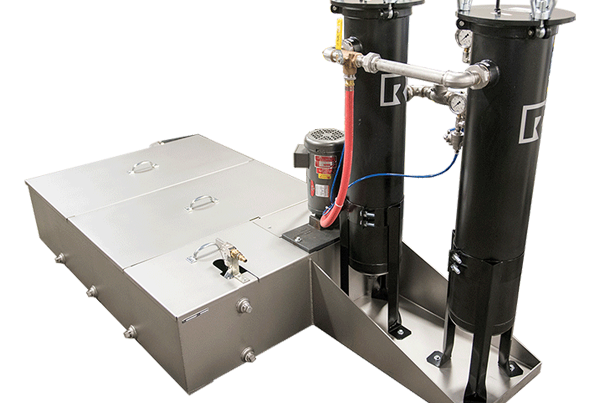
ALMCO offers flexible options for delivering compound to your process. These include both machine and wall mounted systems.
Part Holding Tooling
Custom built fixtures to accomodate your parts and make them easy to load onto the spindle. Multiple fixtures allow for preparation of multiple parts while others process.
Water Recycling
Depending on your application, ALMCO offers a variety of solutions to treat the waste water generated during the tumbling process.
Sutton Model Comparison
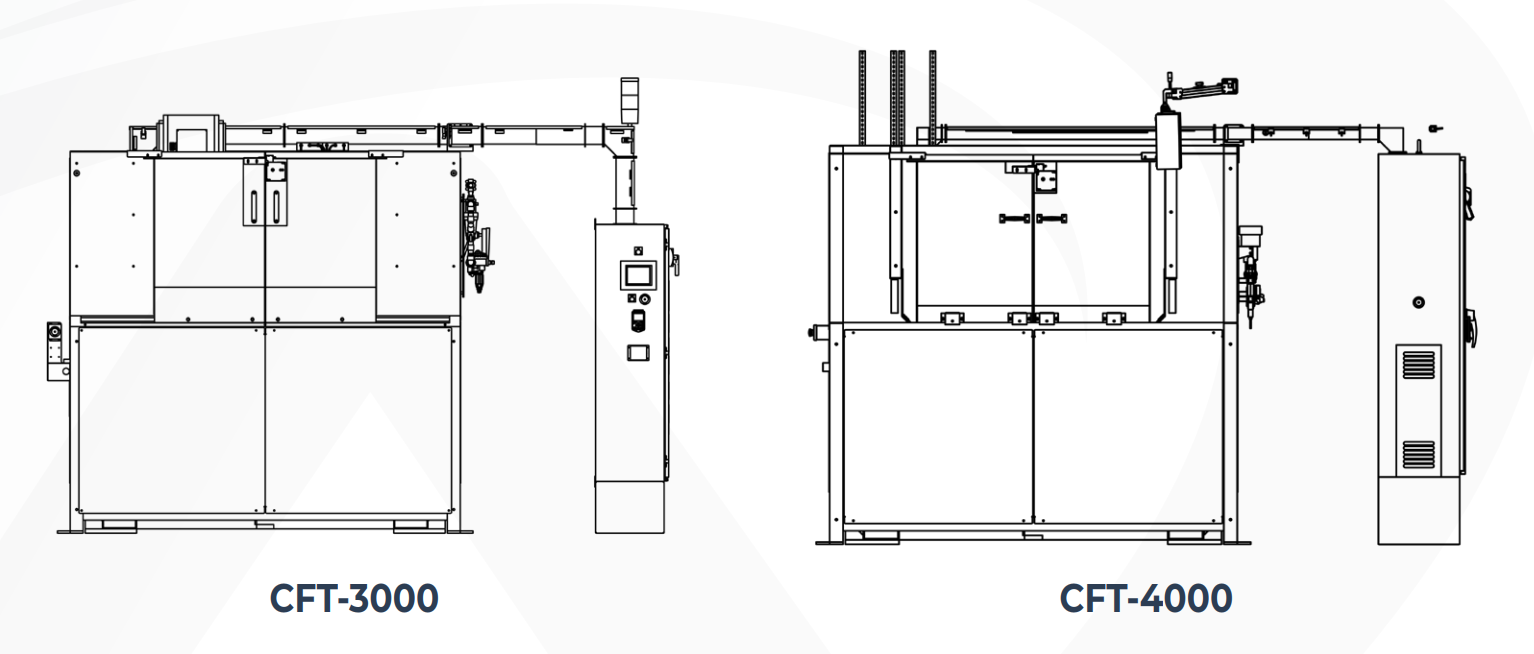
| Spec | CFCA-1100 | CFT-3000 | CFT-4000 |
|---|---|---|---|
| Length | 130″ (approx., front to rear) | 120″ (approx., front to rear) | 132″ (approx., front to rear) |
| Width | 87″ (approx., less free-standing main electrical enclosure) | 100″ (approx., less free-standing main electrical enclosure) | 114″ (approx., less free-standing main electrical enclosure) |
| Height | 96″ (approx. highest point with spindle in down position) | 100″ (approx. highest point with spindle in down position) | 108″ (approx. highest point with spindle in down position) |
| Number of Spindles | 1 | 1 | 1 |
| Spindle Motion | Oscillating | Rotating | Rotating |
| Part Size Range | 45″ Diameter by 8″ thick | Up to 40″ Diameter by 12″ thick | Up to 40″ Diameter by 18″ thick |
| Process Tub Size | 52″ wide x 67″ long x 26″ deep | 59″ wide x 52″ long x 30″ deep | 50″ wide x 76″ long x 40″ deep |
| Process Tub Vibrator Speed | 1,300 RPM (approx.) | 1,300 RPM (approx.) | 1,300 RPM (approx.) |
| Spindle Speed Range | 100-380 reciprocations per minute | 150-900 RPM (75-450 RPM in High-Torque Version) | 100-500 RPM |
| Drive HP | 40 | 50 | 75 |
| Machine Weight | 20,000 lbs. (estimated, empty) | 15,800 lbs. (estimated, empty) | 16,500 lbs. (estimated, empty) |
REQUEST A QUOTE
Let’s talk about the right equipment for your operation.
Tell us about your parts and process. Our team will follow up to discuss the equipment and your application.