
The ALMCO V-16120 Vibratory Tub is the largest standard size offering in ALMCO’s V-Series lineup. This tub allows for an additional two feet of capacity to accomodate long aerospace or ag-equipment components. It can also be divided up to create dozens of smaller chambers while utilizing just one motor for high efficiency.
Vibratory Finishing Equipment
V-16120 VIBRATORY TUB
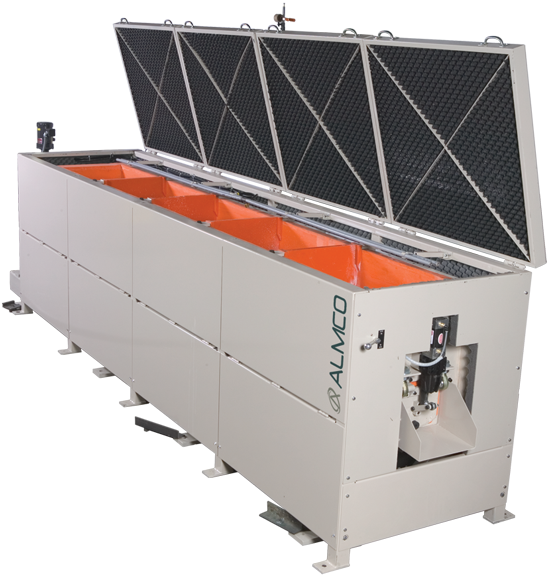
*Shown with optional sound hood and dividers
OVERVIEW
V-16120 Overview
The V-Series Vibratory Tub finishing machines are heavy-duty units built to run all day, every day. They are not just made for running hobby projects on the weekends. These are fully industrial hard working machines made to last for decades. The V-Series may be configured to be part of an automated system, eliminating the need for manual intervention.
The V-1631 tub can tumble finish a variety of parts no matter how much they weigh due to the direct drive shaft system.
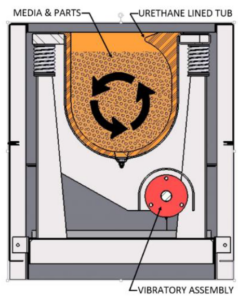
When parts and media are placed into the tub, the counterweights on the spinning vibrator shaft cause the spring-mounted processing tub to rapidly oscillate on its springs. This motion causes the mass of parts and media within the tub to vibrate and roll within the tub in an orderly fashion. This rolling action is controlled by adjusting the speed of the vibrator assembly and by changing the amount of counterweight.
The V-1631 is a rectangular-tub deburring machine designed to be used with steel tumbling media. The machine is intended to be manually loaded and unloaded, and is equipped with an adjustable process cycle timer for batch operation.
KEY ADVANTAGES
- Finish extremely long components
- Eliminate part-on-part contact by using dividers during the tumbling process
- Utilize one system to provide the finishing capacity of four, 5-cubic-foot tubs
- Flexible options for adding compound and other additives to the process
COMMON APPLICATIONS
- Deburring machined, stamped, cast, and forged metal parts
- Edge radiusing to remove sharp edges and improve part safety and handling
- Surface smoothing and Ra value improvement for downstream coating or plating
- Burnishing to produce a bright, uniform surface finish
- Processing large or long parts that exceed round bowl capacity (e.g., wing spars, extrusions, large housings)
TECHNICAL SPECIFICATIONS
| Overall Machine Dimensions (Approximate) | 174″ long x 42″ wide x 52″ high |
|---|---|
| Processing Tub Dimensions | 120″ Long x 19 3/8″ Deep x 16″ Wide |
| Tub Working Capacity | 17 Cubic Feet |
| Tub Lining | 1″ Thick, 90 Durometer Polyurethane |
| Main Motor | 20 HP, 1750 RPM |
| Power Requirement | 460v (Others Available for additional cost) 3 Phase, 60 Cycle |
| Drive Unit | AC Variable Frequency |
| Vibration Frequency | 875 to 1900 RPM |
| Number of Vibratory Mechanisms | Three (3) |
| Operator Controls | 110 volts supplied by a transformer within the control box |
| Electrical Controls | Conformance to N.E.C. electrical specifications |
| Electrical Enclosure | NEMA type 12 panel enclosure mounted on the machine |
| Paint | Two coats of Diamond Vogel brand industrial enamel in Lunar White with Midnight Blue accent |
SYSTEM DETAILS
- Heavy Duty Framework
- The Processing Tub
- How it works
- Spray System
- Discharge Door
- Drive Unit
- Electrical Controls
Heavy Duty Hinges
Heavy Duty Framework
The machine base is a heavy-duty weldment made from plate steel, structural steel tubing and reinforcing gussets. The base has a horizontal deck used for drive motor mounting, and extending up vertically from the deck are four “spring mounting posts” that support the machine’s vibratory tub assembly. Floor pads are provided on the underside of the base to secure the machine to the floor.
Processing Tub
THE PROCESSING TUB
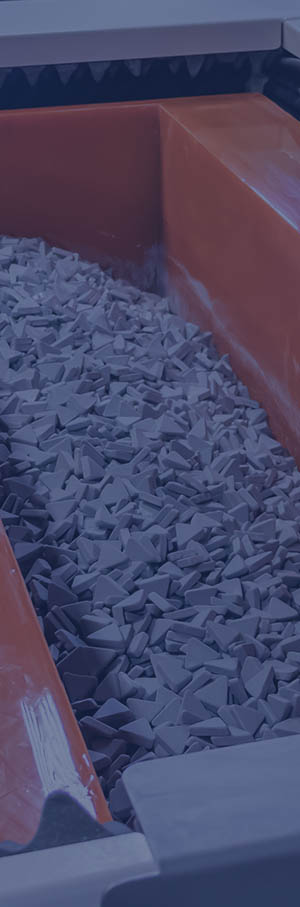
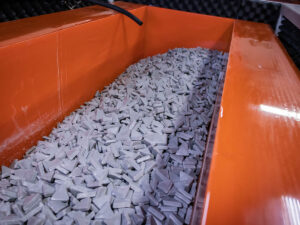
The processing tub assembly consists of a rectangular tub weldment with protective polyurethane lining, a spray system, product discharge door, and vibrator assembly. The tub rests on top of the machine base’s springs, and during operation these springs allow the tub to rapidly oscillate as the vibrators attached to the underside of the tub spin. This vibrating action imparts energy to the process parts within the tub, causing the parts to be cleaned and deburred.
How a Vibratory Tub Works
How it works – Vibratory Shafts
The vibrating motion of the machine’s spring-mounted tub is generated by a vibrator assembly mounted to the underside of the tub. The vibrator consists of a horizontal shaft turning in a pair of 50mm spherical roller bearings pressed into precision-machined housings. The vibrator is connected to the drive unit via automotive-duty U-joint, and the vibrator shaft includes counterweights to provide rotational imbalance, creating the vibrating “action” of the tub.
In operation, the counterweights on the spinning vibrator shaft cause the spring-mounted processing tub to rapidly oscillate on its springs. This motion causes the mass of parts and media within the tub to vibrate and roll within the tub in an orderly fashion. This rolling action can be controlled by adjusting the speed of the vibrator assembly and by changing the amount of counterweight. The tub has a curved baffle on the back side of the tub to assist media roll.
Spray System
SPRAY SYSTEM
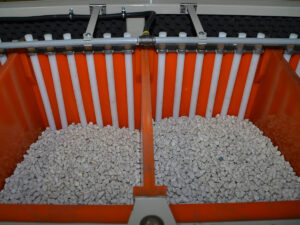
Mounted above and to the rear of the tub is the machine’s spray system, which is used to spray water-based solution onto the contents of the tub during the deburring process. The bottom of the tub is equipped with two molded polyurethane drain plates plumbed to a drainpipe that allows liquid to exit the machine.
Discharge Door
Discharge Door
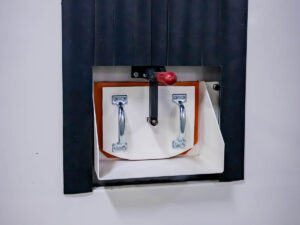
To discharge parts from the tub at the end of the deburring process, one end of the tub is equipped with a manually operated discharge door. This plug-type door includes a tub-mounted clamp that holds the door in place during machine operation, and when the door is removed the contents of the tub flow out of the machine through a short tub-mounted steel chute.
Drive Unit
The machine’s vibrator assembly is driven by a 5 HP, 1750 RPM electric motor powered by an AC variable frequency drive. The motor mounts to the machine base, and the motor drive shaft is connected to the vibrator assembly on the underside of the tub with an automotive-duty U-joint. Frequency of vibration is variable and can be adjusted up to approximately 2500 cycles per minute.
Push Button Controls
Electrical Controls
Electrical controls are housed in a free-standing enclosure. Components within the enclosure are finger-safe and are Allen-Bradley brand unless noted otherwise. Components include a main disconnect switch, fuse holders and branch circuit fuses (as needed), Panduit wireways, terminal strips, a G.E. 115 Volt control circuit transformer, master control relay, and a PowerFlex variable frequency drive.
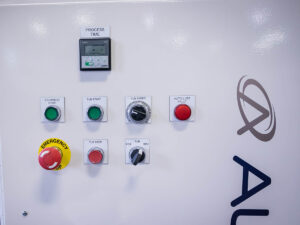
The process cycle timer and all other process control pushbuttons and indicating lights are mounted on the front door of the main electrical enclosure. Buttons and lights are Allen-Bradley brand.
The machine is wired in accordance with NEC (NFPA 70) and NFPA 79 standards, ready for connection to your electrical service.
FREQUENTLY ASKED QUESTIONS
Will vibration from the vibratory tub transfer into the ground and affect other equipment?
The tub is supported in the stationary framework of the machine on heavy coil wound springs mounted on specially designed molded neoprene supports that serve to remove nearly all vibratory motion from the stationary frame of the machine.
Why should I choose a vibratory tub instead of a vibratory bowl?
A vibratory tub is typically preferred when processing:
- Long parts, shafts, tubes, and extrusions
- Large or heavy components
- Parts requiring individual compartment processing
Vibratory Bowls work best for high-volume smaller parts, while tubs provide better control for larger geometries.
How do I calculate the correct tub size?
Part Length: The length of your longest part plus at least 4 to 6 inches of clearance on each side determines the minimum tub length.
Working Volume: Total volume is misleading. Look for the “working capacity,” which accounts for the mandatory 1:3 to 1:5 ratio of parts to abrasive media. Overloading slows cycles and ruins parts.
What electrical and plumbing infrastructure do I need?
ALMCO Industrial vibratory tubs usually require 3-phase power. Confirm your shop floor can support the voltage before purchasing. Wet finishing requires a constant influx of water and compound. You must have a floor drain or a dedicated wastewater treatment system. Most environmental laws prohibit dumping compound effluent directly into municipal sewers.
How often does the lining of the tub need to be replaced?
ALMCO uses the highest standard when it comes to tub lining. With a thickness of one inch and 90 durometer polyurethane, the tub lining should last several years depending on the abrasive level of the media and the amount of run time on the system.
Does it come with sound-dampening features?
The sound level is highly dependent on the type of tumbling media and the parts running in the tub. ALMCO offers an integrated acoustic sound lid to help dampen the noise. Some customers choose to build an insulated room around the tub to further eliminate sound.
What is the total cost of ownership (TCO)?
ALMCO Representatives can help you calculate the working costs of running a continuous vibratory system. These costs include
- Media replacement: Budget for the reality that media breaks down and must be continually replenished.
- Compound usage: Factor in the recurring cost of finishing chemicals.
- Replacement parts: ALMCO stocks replacement springs, drains, and motor bearings locally to avoid extended downtime.
- Electricity: Depending on the voltage the amp draw of running continuously will determine your power costs.
How noisy are vibratory tub machines?
Noise levels will depend largely on:
- The size of the machine
- The type of tumbling media inside (bigger media means more noise)
- The workpiece material and geometry
ALMCO does provide options for deadening the sound of machines. In some cases, rooms are dedicated to vibratory equipment in order to provide increased sound reduction for other parts of a facility.
OPTIONS & UPGRADES
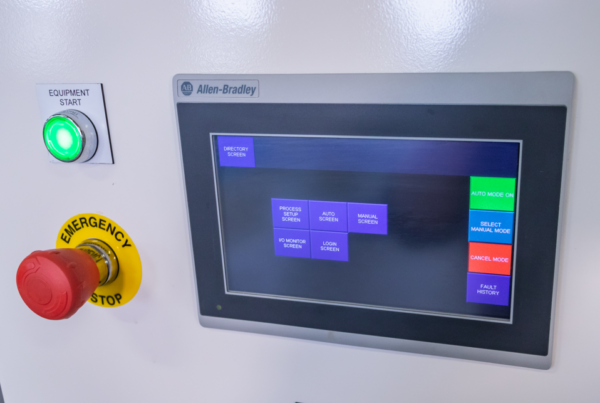
PLC CONTROLLER
The standard control panel can be upgraded to feature a touchscreen HMI interface with PLC controller to allow for greater process control and increased automation.
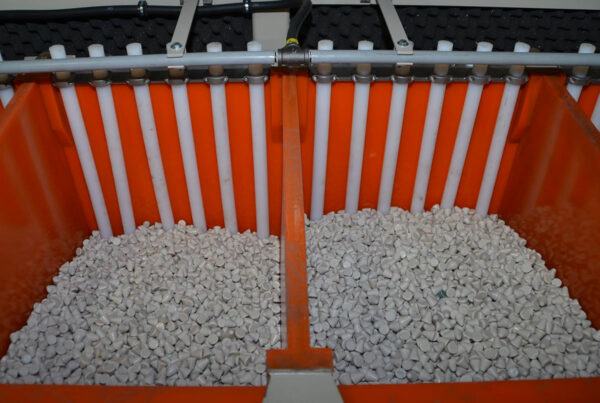
Compound Dosing
ALMCO offers flexible options for delivering compound to your process. These include both machine and wall mounted systems.
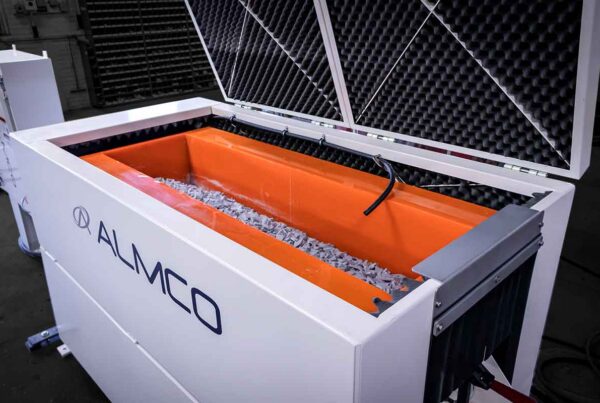
SOUND HOOD
The integrated sound hood helps reduce the noise level of the machine. The metal revolving door and frame are lined with acoustic foam to dampen vibration noise.
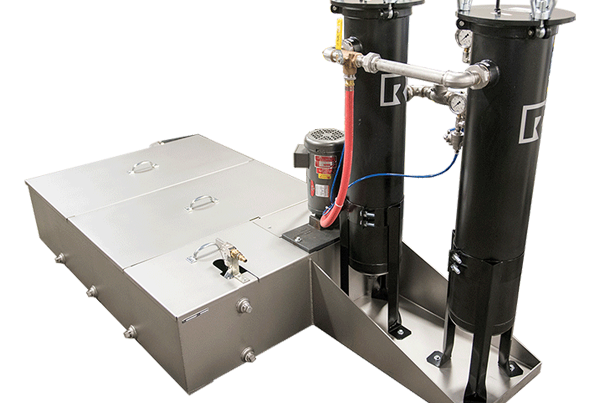
Water Recycling
Depending on your application, ALMCO offers a variety of solutions to treat the waste water generated during the tumbling process.
Thru-Feed Model Comparison
| Spec | V-1631 | V-1661 | V-1696 | V-16120 |
|---|---|---|---|---|
| Working Capacity | 5 | 8.25 | 14 | 17 |
| Motor Size | 5 | 10 | 15 | 20 |
| Overall Dimensions (In) | 80 x 60 x 46 | 110 x 39 x 44 | 146 x 40 x 50 | 174 x 42 x 52 |
| Tub Cross Section | 16″ | 16″ | 16″ | 16″ |
| Tub Length | 31″ | 61″ | 96″ | 120″ |
| Power Consumption at 480v, 3 Phase | 6.25 | 12.5 | 18.75 | 25 |
| Ceramic Media Required (lbs) | 475 | 783.75 | 1330 | 1615 |
| Steel Media Required (lbs) | 1500 | 2475 | 4200 | 5100 |
| Plastic Media Required (lbs) | 325 | 536.25 | 910 | 1105 |
| Maximum Part Size | 14″ Diameter, 30″ Long | 14″ Diameter, 60″ Long | 14″ Diameter, 95″ Long | 14″ Diameter, 119″ Long |
REQUEST A QUOTE
Let’s talk about the right equipment for your operation.
Tell us about your parts and process. Our team will follow up to discuss the equipment and your application.