
A Q&A from the experts.
In mass finishing, Sutton has a reputation for tackling some of the industry’s toughest applications. But what exactly is a Sutton Machine, and why has it become the go-to solution for finishing large aerospace and power-generation components?
To get answers, we sat down with Craig Schmidt, ALMCO Engineering Manager, and Jeff Hoium, Regional Sales Manager, to discuss the Sutton line’s capabilities, advantages, and applications.
What is a Sutton Machine?
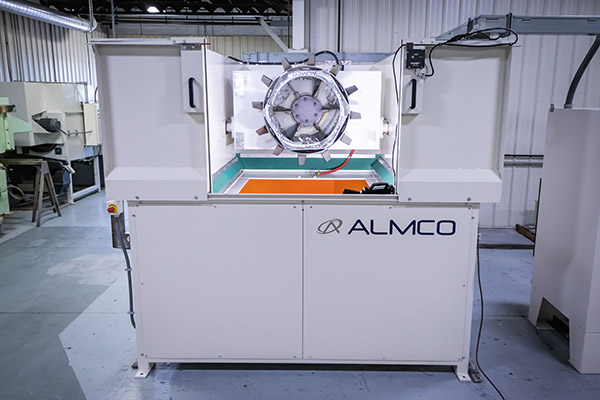
Sutton Machines are heavy-duty spindle finishing systems engineered for aggressive, high-performance surface finishing. Designed primarily for turbine disks, blades, blisks, impellers, and other complex rotating components, Sutton Machines deliver consistent, repeatable results on parts that are often too large or too heavy for conventional finishing equipment.
Built for demanding production environments, these machines combine robust construction with advanced process control to efficiently deburr, edge-radius, refine surfaces, and finish critical components.
Why is the Sutton Machine ideal for turbine disks, blades, blisks, and impellers?
Sutton Machines excel at processing large, heavy components that are typically beyond the practical limits of vibratory finishing systems. Their unique operating design allows manufacturers to use media types and process parameters that would be difficult or impossible to implement in traditional vibratory equipment.
Another advantage is flexibility. Manufacturers can often process parts with varying diameters and heights in the same machine with little to no tooling changeover, helping them maximize productivity while minimizing setup time.
How many Sutton models are available, and how do they differ?
The Sutton product line includes three primary machine platforms, each available in multiple sizes and configurations to meet specific application requirements.
CFT Series
The CFT rotates the part within a vibrating media tub. The programmable control system allows the machine to stop, reverse rotation direction, operate at various angles, and even swing through the media in a pendulum-like motion while rotating. This flexibility helps optimize media contact and finishing performance.
CFCA Series
The CFCA shares many characteristics with the CFT but replaces continuous rotation with rapid oscillation. The part moves back and forth through a 70-degree arc within the vibrating media, creating a highly effective finishing action for specific part geometries and process requirements.
CF Series
The CF operates like a traditional spindle finishing machine, but at much higher rotational speeds. These speeds force the media toward the tub wall, so the spindle must be mounted parallel to the tub floor rather than in the more vertical orientation used in conventional spindle systems.
Sutton vs. Spindle: What’s the Difference?
While both technologies deliver precision finishing, they serve different part sizes and production needs.
A traditional ALMCO 2SF Spindle Machine typically handles smaller components, generally under 12 inches in diameter, 4 inches tall, and weighing less than 50 pounds. These systems are often deployed in high-volume production environments processing hundreds of thousands of parts annually.
By comparison, Sutton CFT and CFCA machines are engineered to handle significantly larger workpieces, with capacities up to 55 inches in diameter, 12 inches tall, and weighing hundreds of pounds. For large aerospace, power-generation, and industrial components, Sutton Machines provide the size, strength, and process control needed to achieve consistent finishing results.