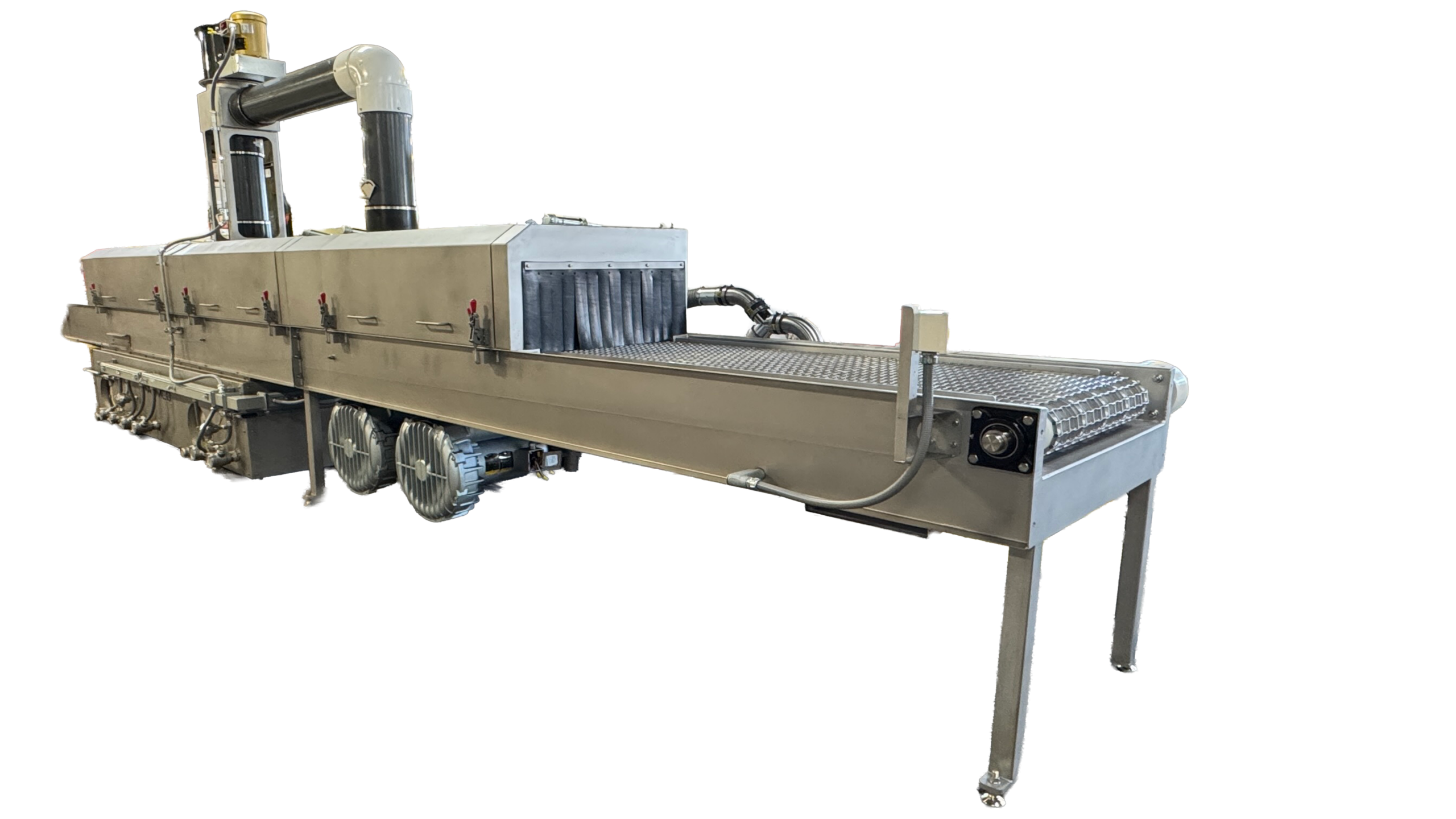

A growing contract manufacturer outgrew its light-duty parts washer as heavier, longer, and more complex parts entered production. ALMCO built a heavier-duty 24-inch conveyor belt washer, with extended load and unload stations, so the shop could clean everything from loaded baskets to full-length raw material on one line.
|
Customer |
Contract manufacturer (name withheld) |
|
Industry |
Contract manufacturing and industrial parts cleaning |
|
Equipment |
24-inch-wide conveyor belt parts washer with extended load and unload stations |
|
Process |
Wash → rinse → intermediate blow-off → final blow-off |
|
Core problem |
Old washer couldn't handle heavier parts, larger baskets or long stock |
|
Outcome |
One washer that handles the full range of the shop's parts (add measured results) |
The customer
The customer is a contract manufacturer that produces parts for OEM customers. Its work changes with each customer program, so its cleaning line has to keep up with whatever comes off the machines next.
In its early years, the shop's parts were smaller and lighter, and a light-duty conveyor washer was enough. As the business won new programs and grew, its part mix changed.
The challenge
Growth brought parts the existing washer was never designed for. The light-duty system had served the shop well, but heavier and longer work pushed it past its limits.
- Heavier components and fully loaded baskets put too much strain on the conveyor and frame, which wasn't rated for those loads.
- Long parts and full-length raw material didn't fit the washer's processing length or its load and unload areas, so they couldn't be run reliably, if at all.
- A wider mix of geometries made thorough rinsing and drying harder, especially on parts that trap fluid.
- Basket size. Larger baskets of smaller parts were needed to maintain throughput, and the old system couldn't handle them.
The result was a cleaning step that couldn't keep pace with the rest of the shop. For a growing shop, that put a ceiling on the work it could take on.
The solution
ALMCO built a 24-inch-wide conveyor belt washer sized for the shop's heaviest and longest work. It wasn't a like-for-like replacement: each change below addresses one of the old washer's limits.
|
Feature |
What it does |
Problem it solves |
|
Higher weight capacity |
Carries heavier components and fully loaded baskets |
Strain on the old conveyor and frame |
|
Extended processing length |
Runs longer parts and full-length raw material through every stage |
Long stock that wouldn't fit |
|
Expanded load and unload stations |
Gives operators room to stage and support long or heavy parts at both ends |
Awkward, unsupported handling of long parts |
|
Wash and rinse stages |
Removes coolants, oils and chips, then rinses residue |
Consistent cleanliness across a wider part mix |
|
Dual blow-off, including an intermediate blow-off |
Clears wash solution before rinse, then dries parts at the exit |
Carryover between stages and wet parts at unload |
|
Adjustable blow-off piping |
Lets the shop aim air at different part sizes and shapes |
Fluid trapped in complex geometries |
Parts move through the washer in a straight line: load → wash → intermediate blow-off → rinse → final blow-off → unload.
Results
The new washer brought parts that had outgrown the old system back onto one automated cleaning line. Heavy parts, large baskets, and full-length material now run through the same wash, rinse, and dry sequence as the rest of the shop's work.
- Capacity matched to the work. The shop can quote heavier and longer jobs without worrying about the cleaning step.
- Easier handling. Extended load and unload stations give operators room to stage long and heavy parts safely.
- Drier, cleaner parts. Dual blow-off and adjustable piping cut carryover and leave parts ready for the next operation.
- Room to grow. The system is sized for where the business is going, not just where it was.
The cleaning step no longer limits the shop's growth.