
For more than 50 years, commercial aircraft in the United States have been prohibited from traveling faster than the speed of sound over land due to concerns about disruptive sonic booms. Now, that restriction is being reconsidered as new technologies make supersonic travel quieter, safer, and more practical than ever before. Recent FAA proposals and federal initiatives are paving the way for a new era of high-speed aviation.
What makes this development especially interesting is that it highlights a familiar theme: innovation often succeeds when we learn how to harness powerful physical forces more effectively.
At ALMCO, we see a similar story unfold every day with ultrasonic cleaning technology.
While supersonic travel utilizes speeds above Mach 1, ultrasonic cleaning uses high-frequency sound waves, typically tens of thousands of cycles per second, to deliver exceptional cleaning performance. In an ultrasonic wash tank, these sound waves create microscopic bubbles that rapidly form and collapse in a process known as cavitation. The energy released during this process reaches into tight geometries, blind holes, and intricate part features that traditional cleaning methods often struggle to reach.
Just as aerospace engineers are rethinking how sound can be used to move people faster across the country, manufacturers are leveraging ultrasonic energy to clean parts more thoroughly, consistently, and efficiently.
- Supersonic technology uses advanced engineering to overcome barriers to faster transportation.
- Ultrasonic technology uses advanced engineering to overcome barriers to cleaner manufacturing.
- Both rely on the science of sound to achieve results that once seemed out of reach.
For manufacturers facing increasingly demanding cleanliness requirements, ultrasonic cleaning has become an essential capability. Whether removing machining oils, fine particulates, polishing compounds, or contaminants trapped in complex part geometries, ALMCO ultrasonic wash systems deliver precision cleaning that supports modern quality standards and production efficiency.
As headlines focus on the future of supersonic flight, we are reminded that some of the most impactful applications of sound are not happening at 40,000 feet. They are happening on the manufacturing floor.
At ALMCO, we are proud to help our customers harness the power of ultrasonic technology to achieve cleaner parts, higher quality, and improved process performance.
The future may be supersonic, but precision manufacturing is already ultrasonic.
THE FUN SCIENCE OF SUPERSONIC
Supersonic technology refers to systems that operate at speeds exceeding the speed of sound (Mach 1). In aviation, this means an aircraft is flying faster than roughly 767–768 mph (1,235 km/h) at sea level, though the exact speed varies with temperature and altitude.
When an airplane flies below the speed of sound, the sound waves it creates travel ahead of it in all directions. People can hear the aircraft before it arrives.
As the aircraft approaches the speed of sound:
- Air in front of the aircraft becomes compressed.
- Sound waves begin to bunch together.
- Aerodynamic drag increases sharply.
- Pressure changes create shock waves.
When the aircraft exceeds Mach 1, it moves faster than its own sound waves. The compressed waves merge into shock waves that form a cone-shaped pattern behind the aircraft, called a Mach cone.
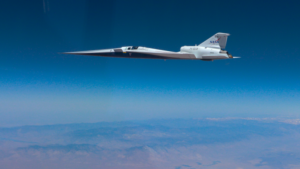
NASA / Lori Losey
NASA and aerospace companies are developing quiet supersonic technologies. For example, NASA’s X-59 uses a long, carefully shaped design intended to spread out shock waves and reduce a loud sonic boom into a much quieter “thump.”