
If you clean chamber hardware, fixtures, or wafer-handling parts for semiconductor production, you already know what’s at stake. One stray particle or thin film of residue can become a wafer defect, a failed qualification, or an unplanned tool-down weeks later.
Manual cleaning with brushes, wipes, and spray wands is slow, hard to repeat, and tough to document. A rotary parts washer removes most of that variability. Here’s how it works, what it means for your parts and your team, and what to ask before you choose one.
What is a rotary parts washer?
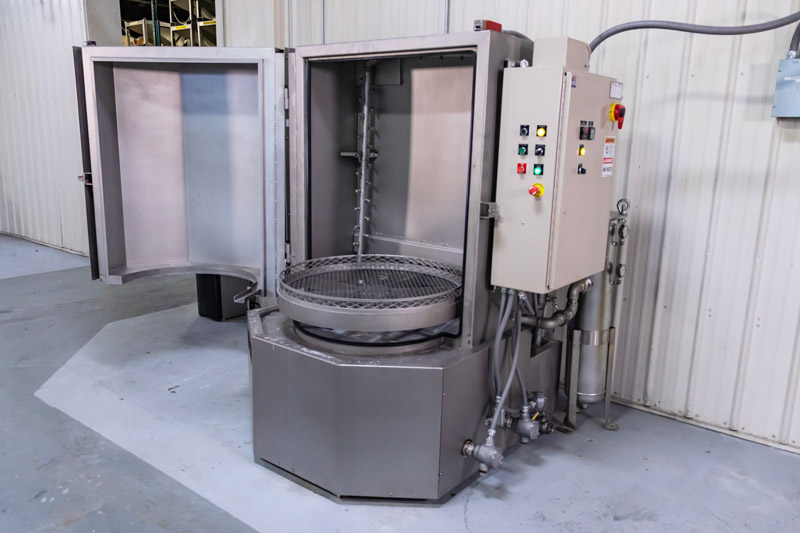
Here’s the mighty but compact rotary parts washer with a 25-inch turntable. The unit shown here offers automated wash-and-dry cycles.
A rotary parts washer is an enclosed cleaning cabinet where parts sit on a turntable or in a basket that slowly rotates past fixed spray jets. Instead of an operator moving a nozzle around a part, the machine moves the part through the spray. Every surface passes the jets the same way, every cycle.
Most systems combine heated cleaning solution, pressurized spray, filtration, and programmable cycles in one cabinet. Units built for precision and semiconductor work add stainless steel construction, deionized (DI) water rinsing, finer filtration, and controlled drying.
How the cleaning cycle works
A typical cycle for semiconductor components runs in five stages. Exact times, temperatures, and chemistries depend on your parts and your cleanliness spec.
-
- Load and fixture. Parts go into a basket or onto the turntable, held in fixtures so they don’t touch, shift, or block each other’s spray. Good fixturing is what lets the spray reach blind holes, gas channels, and undersides.
- Wash. The turntable rotates while spray bars above, below, and beside it direct heated solution at the parts. Rotation keeps changing the spray angle, so contaminants are hit from many directions. Heat, chemistry, and impact pressure work together to loosen oils, machining residue, polishing compounds, and particles.
- Filter and recirculate. Used solution drains back to the tank through strainers and filters that catch what was removed, so dirty fluid isn’t sprayed back onto clean parts.
- Rinse. One or more rinse stages, typically with DI water for semiconductor work, flush away detergent and loosened particles. The final rinse is the last thing that touches your part, so its water quality matters.
- Dry. Heated, filtered air removes water before it can leave spots or residue. Some systems dry in the same chamber; others hand parts off to a separate dryer or cleanroom oven.
Each stage runs from a saved recipe, so the 500th load is cleaned exactly like the first.
What this means for your operation
The real value isn’t only cleaner parts. It’s cleaning you can predict, repeat, and prove.
Consistent results, load after load. Programmed cycles remove operator-to-operator variation, which is often the biggest cause of cleaning failures.
Better reach on complex geometry. Rotation plus multi-angle spray gets into gas distribution holes, threads, and recesses that hand cleaning misses.
Less risk to delicate parts. Fixtures hold parts still, and pressure and temperature are tuned to the material. No scrubbing, dropping, or scratching.
Faster turnaround. Batch cleaning frees technicians for higher-value work and shortens the time spare parts wait before going back into the tool.
Traceability. Many systems log cycle data, which supports quality audits and customer requirements.
A safer workplace. Water-based chemistry in a closed cabinet limits your team’s contact with solvents and hot spray.
Which semiconductor components are a good fit?
Rotary washers do best with parts that can handle spray impingement and need repeatable removal of oils, particles, and residue.
Common examples:
-
- Stainless steel and aluminum chamber hardware, shields, and liners
- Newly machined parts that need first-use cleaning before installation
- Fixtures, trays, tooling, and wafer-handling components
- Bolts, fittings, and small hardware cleaned in baskets
- Ceramic and quartz parts, with gentler settings confirmed by trial
Some jobs need a different or additional process. Heavy deposition films usually need chemical stripping or media blasting first. Parts that must meet the tightest particle specs are often finished with ultrasonic or megasonic cleaning, a final DI rinse, and cleanroom drying and packaging. In those lines, the rotary washer handles the high-volume wash step so the precision steps work better.
Questions to ask before you buy
Bring these to any supplier conversation:
-
- What contaminants are we removing?
-
- Oils, polishing compounds, particles, and process residues each call for different chemistry and temperatures.
-
- What are our parts made of?
-
- Aluminum, stainless, anodized surfaces, ceramics, and plastics each tolerate heat and pH differently.
-
- What cleanliness level must we prove, and how?
-
- Ask how the supplier verifies results against your spec, such as particle counts or residue testing.
-
- How big are our largest parts and batches?
-
- Turntable diameter, chamber height, and weight capacity decide what fits.
-
- Does it rinse with DI water and dry without spotting?
-
- For semiconductor parts, rinse and dry matter as much as the wash.
-
- Can we test our own parts first?
-
- A cleaning trial on your actual components best predicts results.
-
- What does ownership look like?
-
- Ask about filter changes, water and chemistry use, routine maintenance, and service support.
-
- What contaminants are we removing?
The results matter most.
A rotary parts washer cleans semiconductor components by turning them through heated, filtered spray from every angle, then rinsing and drying them in a controlled, repeatable cycle. For you, that means fewer cleaning-related defects, faster turnaround on critical parts, and a process you can document.
Not sure it fits your components? Send us a few sample parts for a cleaning trial, and we’ll show you the results before you commit.
FREQUENTLY ASKED QUESTIONS
Can a rotary parts washer replace ultrasonic cleaning?
Not always. Spray cleaning is excellent for bulk soil, exposed-surface particles, and high throughput. Ultrasonic cleaning reaches microscopic crevices and is often added for the most critical parts. Many lines use both.
Is spray cleaning safe for delicate semiconductor parts?
Yes, when the cycle is set for the part. Pressure, temperature, chemistry, and cycle time are all adjustable, and fixtures prevent parts from colliding.
What cleaning chemistry is used?
Most systems use water-based detergents matched to the soil and the material being cleaned, followed by a DI water rinse. Your washer supplier or chemistry vendor should confirm compatibility with your materials.
Why does DI water matter in the rinse?
Tap water carries minerals and ions that can dry onto parts as spots or residue. DI water removes those minerals and ions, so the final rinse doesn’t reintroduce contamination.
Can a rotary washer be used near a cleanroom?
Yes. Washers often sit in a gray area next to the cleanroom, with parts passed through for final inspection and packaging. Ask about stainless construction, filtered drying air, and pass-through options.